“When you remove genetics from the equation, you finally see what a cream is actually doing. In most cases, the answer is very little.” — Professor Charlotte Weber, University Hospital Zürich
Reviewed by Dr. Laura Schmidt, MD, FAAD
You look in the mirror one morning and something has changed.
Not overnight, not dramatically. But the lines around your eyes are deeper than they were six months ago. Your jaw is a little less defined. The skin along your cheeks carries a heaviness it did not used to have.
And you are doing everything right. You cleanse, you moisturise, you wear sunscreen. You are using a good cream, maybe even an expensive one.
So why does the mirror keep telling you it is not working?
There is the serum a friend swore by. The jar bought on the strength of its packaging. The formula used faithfully for a month, then pushed to the back of the drawer. After enough of them, the easy conclusion is that the fault lies in your skin, or in not being diligent enough.
The harder possibility is rarely considered: that the cream itself simply did nothing.
That has always been difficult to prove. Skin ages at a different rate in every woman, shaped by genetics, sun, sleep and stress. So when a cream seems to work on one face and fail on another, no one can separate the product from the luck of good genes.
Which is why the question of whether these creams actually work has stayed conveniently unanswered.
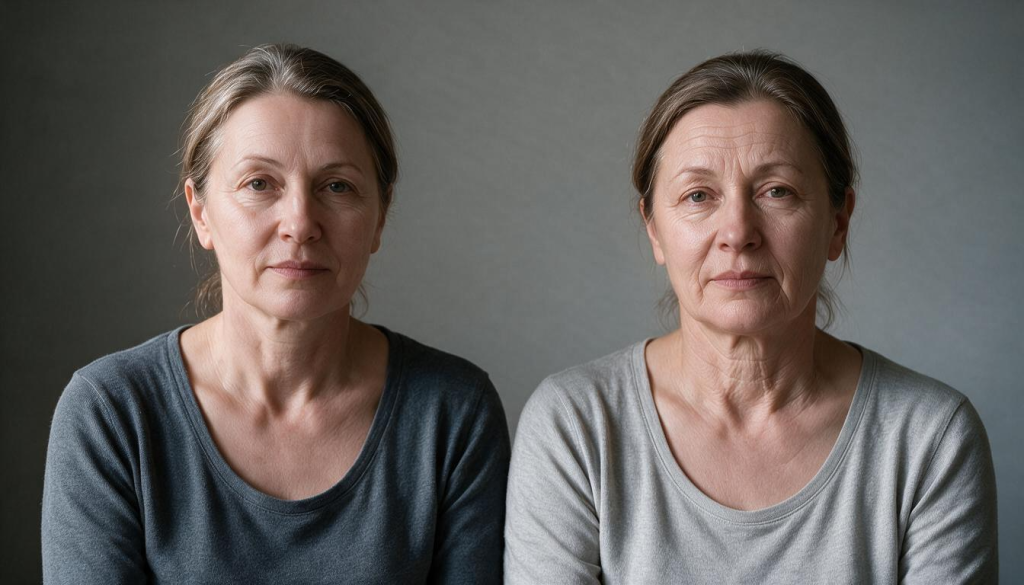
A group of European researchers set out to answer it, with a method simple in its logic. To remove genetics from the equation, they tested each cream on two women who share the same genes. Identical twins.
Twins share the same DNA, the same collagen genes, the same lifelong sun exposure. Biologically, their skin is the same skin.
So if one sister uses a cream and the other does not, any difference between them cannot be genetics, lifestyle or luck. Only one variable is left. The cream.
The Study

Over fourteen months, an independent European research group ran what is, in effect, the cleanest experiment skincare allows.
They recruited 34 pairs of identical twins. Within each pair, one sister applied a given anti-aging cream twice daily while the other used only a plain, fragrance-free moisturizer as a control. Same household. Same diet. Same climate. The only variable permitted to differ was the product itself.
In total they tested 92 of Europe’s best-selling anti-aging creams, one pair of twins at a time.
The measurements were where the study earned its credibility.
Wrinkle depth was captured by profilometry, a technique that maps the skin’s surface in three dimensions to a resolution of fractions of a millimeter, far below what any eye can judge. Firmness and elasticity were recorded with a Cutometer, the instrument dermatologists use to measure how quickly skin recoils after being gently drawn.
Perceived age was assessed by DermoScan360, an AI imaging system trained on tens of thousands of faces, and then confirmed by a panel of dermatologists who were never told which twin had used which cream.
No before-and-after photographs open to interpretation. No volunteers reporting how they felt. Two genetically identical faces, measured against each other by instruments that do not flatter.
The design left almost nowhere for a cream to hide.
Results Preview: 5 Creams Worked Out Of 92

Across the 92 creams tested, the pattern was consistent and, for the beauty industry, uncomfortable.
On 87 of them, the treated twin was statistically indistinguishable from her untreated sister. Measured on wrinkle depth, firmness and perceived age, the woman using the cream and the woman using plain moisturizer returned effectively the same readings.
Cost had no bearing on the outcome. Several of the products that registered no measurable effect were among the most expensive in the study.
Five creams were the exception. And within those five, one pair produced the widest gap recorded in the entire fourteen months.
- After twelve weeks, the twin using the #1 ranked cream measured 4.3 years younger than her sister on the DermoScan360 scale. Her skin tested 31% firmer on the Cutometer, and profilometry recorded her wrinkles as 27% shallower. Her sister’s readings had barely shifted.
- The second cream produced a 2.6 year difference in perceived age, with a 19% improvement in firmness. The third opened a gap of 1.9 years, alongside a measurable rise in surface hydration and texture.
Three women, each measurably younger than her own identical twin. In a category where most products fail to outperform a basic moisturizer, the researchers treated the result as unusually clear.
It also raised an obvious question.
The five creams came from different brands, different countries and very different price points. They shared no obvious feature.
What those five were doing that the other 87 were not became the focus of the study’s second phase.
When They Swapped the Creams, the Faces Swapped Too

A ranking only shows which creams the younger-looking sisters had used. It does not prove the cream caused the difference.
To test causation directly, the researchers added a crossover phase, a design used in clinical trials to isolate cause.
They returned to the pair with the widest divergence, the sisters separated by 4.3 years. One had used the top-ranked cream throughout. The other had used the control moisturizer and measured significantly older.
Then the two protocols were exchanged.
The sister on the top-ranked cream was moved to a formula from the bottom decile of the 92. The sister on the control was placed on the top-ranked cream for the first time, on the same twice-daily protocol.
If the original result had been chance, the gap would hold.
It reversed.
Within four weeks, the sister newly on the top-ranked cream began to close the gap. Profilometry recorded her wrinkle depth down 9%. The Cutometer measured elasticity up 9%. On the DermoScan360 scale her perceived age fell 1.6 years from the crossover point, and was still moving.
Over the same period, the sister moved to the low-ranked formula regressed, surrendering nearly half her prior advantage.
The measured difference tracked the cream, not the individual.
“At that point it was no longer a correlation,” noted Dr. Helena Bergström of the Stockholm Institute for Dermatological Research. “We could move the outcome by moving the product, then reverse it again. In a topical study, that is as close to causation as the method allows.”
Five creams, from five unrelated manufacturers, had produced an effect the other 87 could not. The next question was what those five formulas contained.
The 87 That Failed Were Almost The Same Cream

When the researchers lined up all 92 formulas side by side, the failures gave up a secret.
The 87 creams that did nothing were, chemically, almost interchangeable.
Read the labels on the anti-aging creams in any pharmacy and the same names repeat: Retinol. Hyaluronic acid. Niacinamide. Vitamin C. Peptides. Ceramides. Different brands, different prices, the same short roster of actives at slightly different doses.
“If you audited the fifty best-selling creams in Europe, most would be variations on the same six or seven ingredients,” said Marcus Bauer, PhD, of the Institute for Skin Biology in Munich. “The real differences are in the marketing, not the chemistry.”
These are not bad ingredients. They are well studied and genuinely useful. The catch is where they work.
Every one of them acts on the surface. And the five creams that beat their twins were doing something the surface cannot explain.
To see what, you have to look at where skin actually ages.
The Three Levels Where Skin Ages

To understand why five creams succeeded where 87 failed, it helps to know something dermatology now broadly agrees on. Skin does not age in one place. It ages on three separate levels, and each demands a different kind of intervention.
Almost every cream on the market only reaches the first.
Level One: The Surface
The top layer is where the visible signs live. Fine lines, dryness, dullness, a texture that no longer catches the light the way it once did.
This is where the familiar ingredients act. Retinol, hyaluronic acid and niacinamide hydrate the outermost layer and smooth its appearance, and the improvement is genuine.
But it is cosmetic.
“The majority of topical actives never pass beyond the outermost layers of the skin,” notes Marcus Bauer, PhD, of the Institute for Skin Biology in Munich. “They change how skin looks without changing what it is doing.”
Stop the cream and the surface returns to where it started, because nothing beneath it has moved.
Level Two: The Structure
Below the surface lies the layer that gives skin its architecture: the dermis, where collagen and elastin form the scaffolding that keeps skin firm and springy.
The decline here can be measured precisely. Collagen production falls by roughly 1% every year after the age of 20. By 30 the skin has lost around 10% of it. By 40, closer to 20%. In women, menopause accelerates this sharply, stripping as much as 30% of skin collagen within five years as estrogen falls away.
Sun does further damage. Around 80% of visible facial aging is driven by UV exposure, not by the passage of time, as reactive oxygen species fragment collagen and elastin faster than the skin can rebuild them.
This is the level good peptide and retinoid formulas reach, prompting the dermis to lay down new collagen. The better structural creams earn measurable firmness gains for it.
But even these plateau, because they leave the deepest driver of aging untouched.
Level Three: The Cell
The third level is the one almost no cream reaches, and it is where the aging actually starts.
Collagen does not simply vanish. It is built by cells called fibroblasts, and with age these cells slow down and fall quiet, producing less and repairing less. As they do, the whole structure above them loses its supply line.
The renewal machinery slows with them. Cell turnover that runs on a roughly 28-day cycle in young skin stretches toward 40 days with age, so damaged cells linger instead of being cleared and replaced.
“The structural and surface changes we see are downstream,” says Professor Charlotte Weber of University Hospital Zürich. “They are the visible consequences of a slowdown happening at the level of the cell itself. Treat only the surface and you are treating a symptom.”
This is the engine beneath the other two. When fibroblasts fall quiet and renewal slows, the dermis has less collagen to work with, and the surface loses the support that keeps it smooth. Every visible sign traces back here.
It is also why surface and structural creams eventually run out of road. They are treating the consequences of a slowdown happening one level below them.
Most creams paint the walls of a house whose foundation is quietly giving way. The five that beat their twins were the rare few working at the foundation itself.
What Happens At The Cellular Level
For decades the cellular level of aging was a black box. Then, in 2009, three scientists shared the Nobel Prize in Physiology or Medicine for uncovering part of what goes on inside it. Their work pointed to a structure most people have never heard of, sitting at the very end of every strand of DNA.
It reframes how you read every cream you have ever bought.
The Clock Inside Every Cell

Picture the plastic tip on a shoelace, the part that keeps it from fraying. A telomere does the same job for a chromosome. It is a protective cap on the end of your DNA.
Every time a cell divides to make new skin, that cap gets fractionally shorter. Divide enough times and it runs down to almost nothing. At that point the cell can no longer divide. It stops renewing and falls quiet.
This is what happens to the fibroblasts in aging skin. As their telomeres shorten, they produce less collagen and eventually stop dividing altogether. The structural collagen loss you can measure begins here, as a clock winding down inside the cell.
The Cells That Refuse To Die

There is a second problem, and it may be worse.
When a cell becomes too damaged to work, it is meant to die and be cleared away. Some refuse. They can no longer divide, yet they will not die either. Biologists call them senescent cells. In plain terms, zombie cells.
They would be harmless if they simply sat there. Instead they leak a steady stream of inflammatory compounds that damage the healthy cells around them and break down nearby collagen. One dermatologist likens it to a single rotten apple in a basket. It does not just take up space. It makes every apple near it rot faster.
The more they accumulate, the faster the surrounding tissue ages.
Two Problems The Surface Cannot Reach

These are the two engines of cellular aging. A shortening clock that slows renewal, and a population of zombie cells that actively degrades the tissue around them.
Both sit far below the reach of hydration or surface smoothing. No amount of moisture reaches a telomere. No exfoliant clears a senescent cell. This is why the 87 creams failed. They were working on the top of the skin while the aging continued, untouched, underneath.
The five that beat their twins had somehow reached this level. Which returned the researchers to the question they had been chasing from the start.
If it was not hydration, and not the usual surface actives, then what exactly were those five formulas made of?
The Ingredients That Actually Reach The Cell

Only a small handful of compounds can act at the cellular level. Each of the five winners was built on at least one of them. Here is what the evidence shows, ingredient by ingredient.
Telomerase activators: restarting the clock
This is the class that addresses the shortening telomere directly. By raising telomerase activity, the enzyme that maintains telomere length, they let quiet fibroblasts divide again.
The importance of this enzyme is not fringe science. Its discovery earned the 2009 Nobel Prize in Medicine, and fibroblast decline is now well quantified: after 40, fibroblasts lose roughly 10% of their replicative capacity every decade, which is the measurable root of collagen loss.
The most studied cosmetic compound in this class is Vitasource. In laboratory testing it restored fibroblast replication to a rate associated with skin a full decade younger, measured by cell-duplication assay. It does not deposit collagen onto the skin. It reactivates the cells that produce it, which is why its firmness gains hold rather than fade.
Senolytics: clearing the zombie cells
The second class targets the senescent cells, the zombie cells that leak inflammation into surrounding tissue. These compounds trigger apoptosis, the programmed cell death that senescent cells otherwise evade.
The standout is Altheostem. In vitro, it reduced the senescent-cell population by 44%. In a separate clinical study it delivered a measured perceived-age reduction of 3.26 years after eight weeks, with improvements of up to 5.7 years in the periocular area, the thin skin around the eyes where aging shows first.
Clearing these cells does not just slow damage. It lets the healthy tissue around them recover, which is why senolytic activity tends to improve skin quality broadly rather than in one dimension.
The supporting cast worth looking for
Bakuchiol, a plant-derived retinol alternative, has shown renewal and antioxidant activity in controlled trials without retinol’s irritation. Resveratrol and related cellular antioxidants defend the mitochondria against the oxidative stress that ages cells from within. Both are genuine markers of a serious cellular formula.
The ingredient that sounds impressive and rarely delivers
Growth-factor complexes dominate premium labels and test well in isolation. The problem is molecular weight. The proteins are usually far too large to cross the skin barrier, so most of the effect promised on the box never reaches a living cell. A caution worth carrying into any purchase.
The pattern across all five winners was consistent. Length of ingredient list meant nothing. What mattered was whether a formula reached the cell, and whether it addressed the clock, the zombie cells, or both.
Only one of the five addressed both, at full concentration.
The Final Ranking: 5 Creams That Passed the Twin Test

Five creams, out of 92, opened a measurable gap between the treated sister and her untreated twin. That alone placed them in rare company. Eighty-seven others changed nothing an instrument could detect.
But the five were not equal, and they separated by one thing above all: how deep into the skin each one reached. The surface, the structure, or the cell itself. The deeper a cream reached, the wider the gap it opened between the sisters.
Each was scored out of 100, on wrinkle depth, firmness, and how well the results held across the full twelve weeks. The panel graded without knowing which twin used which cream.
1. Cellexia Cellular Renewal Cream. Scored 96 out of 100.

This was the cream behind the widest gap in the study, the sisters separated by 4.3 years of perceived age. It reached deeper than any other formula tested, to the cellular level, and it was the only one to address both problems found there.
Instrument readings at week 12:
- Profilometry (wrinkle depth): -31.2%
- Cutometer (elasticity): +36.5%
- Corneometer (hydration): +28.3%
- TEWL (barrier function): -24.7%
- Mexameter (pigmentation): -18.4%
Wrinkle-depth timeline:
- Week 4: 12.1%
- Week 8: 23.4%
- Week 12: 31.2%, still climbing
The timeline is what set it apart. At week 4 its treated twin was level with the field. By week 8 her improvement had nearly doubled. By week 12 it reached 31.2% and was still rising when testing stopped. Every other cream had leveled off by week 8. This was the only one still gaining ground at the end.
The reason sits in two ingredients, one for each cellular problem.
The first, Vitasource, works on the shortening clock. It supports telomerase, the enzyme that maintains the protective caps on the ends of the DNA, helping quiet fibroblasts divide again as if they were 10 years younger. It does not lay collagen onto the skin. It reactivates the cells that make it.
The second, Altheostem, works on the zombie cells. It triggers the programmed death that senescent cells otherwise evade, cutting their number by 44% and clearing the way for healthy tissue to recover.
Reawaken the dormant cells, clear out the poisoned ones. No other cream in the study did both, and that is why its results compounded while every other formula reached a ceiling and stopped. It was not smoothing the surface or reinforcing the structure. It was changing how the cells themselves behave, at the level where aging begins.
The formula draws on the 2009 Nobel Prize-winning telomere research of Dr Elizabeth Blackburn, and the brand holds the 2026 European Cosmetic Prize, awarded by an independent jury of 27 dermatologists after evaluating 350 brands. It comes not from a global name but from a small family laboratory in Ireland.
2. Drunk Elephant Protini Polypeptide Cream. Scored 88 out of 100.

The closest challenger, and a genuinely strong cream. It was the only other formula to reach past the surface, working at the structural level through a nine-peptide complex that prompts collagen and supports the skin’s scaffolding. Its treated twin pulled clearly ahead of her sister, outperforming every surface cream in the study.
Instrument readings at week 12:
- Profilometry (wrinkle depth): -19.3%
- Cutometer (elasticity): +21.6%
- Corneometer (hydration): +24.1%
- TEWL (barrier function): -15.2%
- Mexameter (pigmentation): -8.7%
Wrinkle-depth timeline:
- Week 4: 15.8%
- Week 8: 18.9%
- Week 12: 19.3%
The timeline reveals both its strength and its limit. At week 4 this cream led the entire study, its treated twin ahead of every other pair, the eventual winner included. The peptides went to work quickly, signaling the skin’s existing cells to firm and rebuild, and the early gains were the fastest in the test.
Then it leveled off. The gain from week 8 to week 12 was slight, and the curve flattened while the winner was still climbing.
The reason is precise. Peptides optimize cells that are still working. They send useful instructions to fibroblasts that can still respond. But they cannot restart a fibroblast whose telomeres have wound down, and they cannot clear a senescent cell. Once the working cells are fully optimized, the formula has done all it can, and there is nowhere further to go.
This is the natural ceiling of a cream that reaches the structure but not the cell. It opened a real and lasting gap between the sisters, then held there. A strong result that stopped at exactly the point where the winner accelerated past it.
3. Caudalie Premier Cru The Cream. Scored 84 out of 100.

A strong French formula built around grape-derived antioxidants, and a favorite for good reason. Its treated twin showed clearly improved radiance and a more even tone, and the environmental protection it provides is real. It is gentle enough for sensitive skin, which several formulas at this level are not.
Instrument readings at week 12:
- Profilometry (wrinkle depth): -14.6%
- Cutometer (elasticity): +16.0%
- Corneometer (hydration): +21.7%
- TEWL (barrier function): -12.3%
- Mexameter (pigmentation): -11.2%
Wrinkle-depth timeline:
- Week 4: 11.4%
- Week 8: 13.8%
- Week 12: 14.6%
Its ceiling is built into how antioxidants work. Compounds like resveratrol neutralize the free radicals that damage skin, which means their real value is in preventing damage that has not happened yet. Against a sister already showing lines, prevention has less to correct.
The curve reflects it. Improvement arrived early, then flattened after week 4, because once the skin’s antioxidant defenses are topped up, there is little more the formula can add.
In the study’s terms, antioxidant defense guards the cell from the outside. It slows the arrival of new damage, but it does nothing for the clock winding down within the cell, or for the zombie cells accumulating around it. Excellent at what it sets out to do. A shield, not a repair crew.
4. Kiehl’s Super Multi-Corrective Cream. Scored 80 out of 100.

A trusted heritage formula that sets out to address firmness, lines, texture and radiance all at once. Its treated twin improved on every measure, modestly but genuinely, and the even, all-round improvement is a real strength for anyone wanting one simple step rather than a routine.
Instrument readings at week 12:
- Profilometry (wrinkle depth): -11.8%
- Cutometer (elasticity): +12.2%
- Corneometer (hydration): +18.2%
- TEWL (barrier function): -9.4%
- Mexameter (pigmentation): -7.3%
Wrinkle-depth timeline:
- Week 4: 7.2%
- Week 8: 10.1%
- Week 12: 11.8%
The limit here is arithmetic. A formula has only so much room, and spreading it across many actives at once means the concentration of each is necessarily lower. Every result comes back real but none comes back large, because no single mechanism is dosed strongly enough to dominate.
The curve rose slowly and steadily across the twelve weeks, improvement without a strong engine behind it. It never stalled, but it never surged either.
It works several surface concerns at a gentle level, all at the same time. Its treated twin opened a modest, even gap over her sister, and the broad, diluted approach is precisely what kept that gap from widening into something dramatic. A capable generalist that trades depth for breadth.
5. Shiseido Benefiance Wrinkle Smoothing Cream. Scored 77 out of 100.

A Japanese formula built around immediate smoothing and sensorial luxury, and very good at both. Within days its treated twin’s skin looked smoother and felt softer, and it sat beautifully under makeup. As a daily experience, it was the most pleasant cream in the test.
Instrument readings at week 12:
- Profilometry (wrinkle depth): -9.7%
- Cutometer (elasticity): +8.3%
- Corneometer (hydration): +19.4%
- TEWL (barrier function): -6.8%
- Mexameter (pigmentation): -4.1%
Wrinkle-depth timeline:
- Week 4: 8.9%
- Week 8: 9.5%
- Week 12: 9.7%
Almost the entire result arrived in the first four weeks, then held steady for the remaining eight. The pattern makes sense once you understand the formula’s aim. Rather than delivering strong actives itself, it is designed to make skin more receptive to whatever is applied, improving the surface quickly and then maintaining that improved surface.
That is a real benefit, and the hydration and smoothing scores show it. But it is surface work by design. The formula optimizes how skin looks and feels without changing what is happening beneath it, which is why the curve plateaued so early and so completely.
Its treated twin pulled ahead of her sister, but by the narrowest margin of the five. A polished, pleasant surface cream that opened the smallest gap of the group.
What The Ranking Shows
Read down the five and the pattern is impossible to miss. The ceiling of each cream was set by the depth it reached.
The surface creams improved how skin looked, then plateaued within a month. The antioxidant formula protected against new damage but could not undo the old. The peptide cream reached the structure and led the field early, then stalled where the living cells stopped responding. Each opened a real gap between the sisters, and each ran out of road at the exact depth its ingredients could travel.
Only one cream kept improving through week 12, because only one was working at the level where aging actually begins.
Every cream in this ranking painted the walls, some more beautifully than others. One rebuilt the foundation.
Disclaimer: This article presents a comparative cosmetic product evaluation conducted using predefined assessment criteria focused on formulation characteristics and consumer-relevant performance factors.
This content is not a medical study, clinical trial, or regulatory certification. Products are assessed comparatively within the context of this evaluation framework only, and rankings reflect relative performance within the evaluated group, not guaranteed results.
Products featured are commercially available. The publisher of this website receives a commercial benefit from consumer interest in certain products referenced.
Inclusion or ranking position does not constitute endorsement, certification, or approval by any regulatory authority. Consumers should consider ingredient information, personal needs, and independent sources when making purchasing decisions.