SCIENCE & AGEING
“Based on the research and what I’ve measured over two decades, almost no cream reaches the cellular layer where ageing is actually controlled.”
Professor Charlotte Weber, MD, board-certified dermatologist, 25 years specialising in ageing skin, principal investigator on 47 clinical trials
Published 17 November 2026 · Updated 17 November 2026 · 22 min read
Medically reviewed by Professor Charlotte Weber, MD · Fact-checked by Laura Schmidt, MD, FRCP
You look in the mirror one morning and something has changed. The lines around your eyes look deeper than they did six months ago.
Your jawline is a little softer. The skin along your cheeks has a heaviness it didn’t have before.
You’re using a good cream, maybe even an expensive one. You cleanse, moisturise and wear sunscreen every day. So why does your face keep ageing as if you were doing nothing at all?
For two decades, I watched women spend hundreds of euros on creams that promised to turn back the clock. Some of those jars cost more than a week’s groceries.
And they left the same lines staring back from the mirror every morning. I didn’t have a good answer for those women until last year.
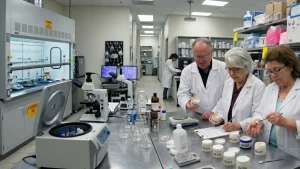
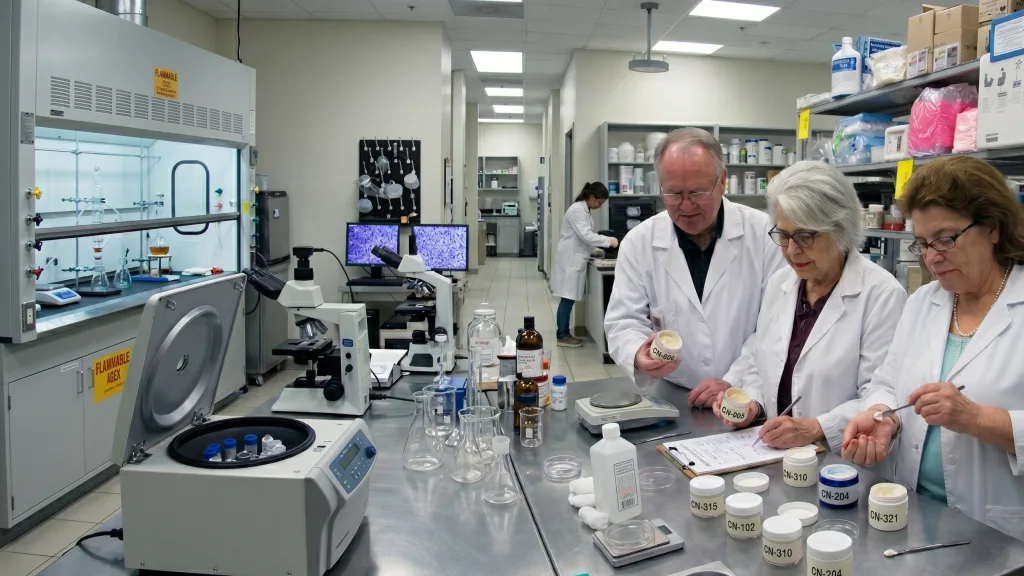
That’s when an independent team of dermatologists and cosmetic chemists set out to find which face creams actually work below the surface. They put 127 creams through 12 weeks of laboratory measurements.
The list reads like the shelves of a department store: La Mer, Lancôme, Estée Lauder, Clinique, Clarins, Olay, L’Oréal Paris, Shiseido, Kiehl’s, Caudalie, Drunk Elephant and more than a hundred others.
Out of 127, only 5 passed.
Some of the biggest names in skincare failed. One luxury cream that sells for more than €180 a jar did not even make the top 10.
What separated the five winners explains why so many good creams stop working. Your skin ages on three layers at once, and most creams only reach the first.
The five creams that passed all reached deeper. Several delivered strong results in the first few weeks. And one of them, a cream most women have never heard of, was still improving when the study ended, with wrinkle depth down 31% at week 12.
This investigation by Beauty Review Mag explains the three layers, why most creams never get past the first, and which five creams did.
Key findings of this investigation
- The five best creams reduced wrinkle depth by up to 31% in 12 weeks.
- In a separate clinical study, the top cream reduced wrinkles around the eyes by 47% and made skin 33% firmer in 8 weeks.¹⁶
- Women using it were judged up to 3.26 years younger, and up to 5.7 years younger around the eyes.¹⁵
- Most creams stop improving after week 8. The best ones keep going.
- Most expensive creams fail for a simple reason: their key ingredients are too big to get into your skin.²
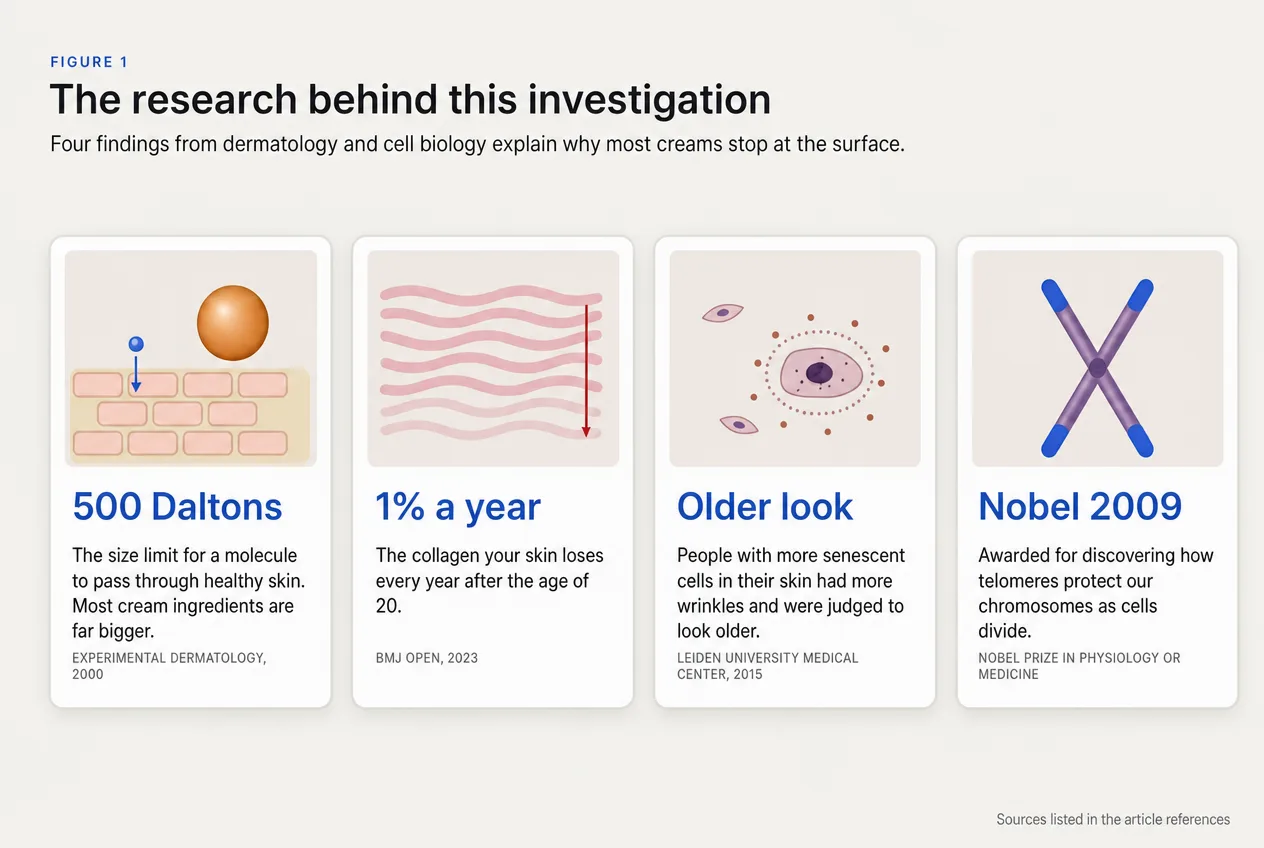
The Finding That Explains Why No Cream You’ve Tried Has Touched Your Deepest Wrinkles
Here’s what most skincare brands won’t tell you: the vast majority of face creams, including many of the most expensive ones, only treat the surface of your skin.
They hydrate the top layer and plump it for a few hours. Your skin looks smoother until the evening, and then it’s back to where it started.
Every morning when you apply your cream, you’re putting a fresh coat of paint on a wall that’s crumbling from the inside. The paint looks fine, and the wall keeps crumbling.
Researchers now describe skin ageing as a process that happens on three distinct layers, each driven by something different.¹ Most face creams only address the first, which is why so many women feel their routine isn’t working.
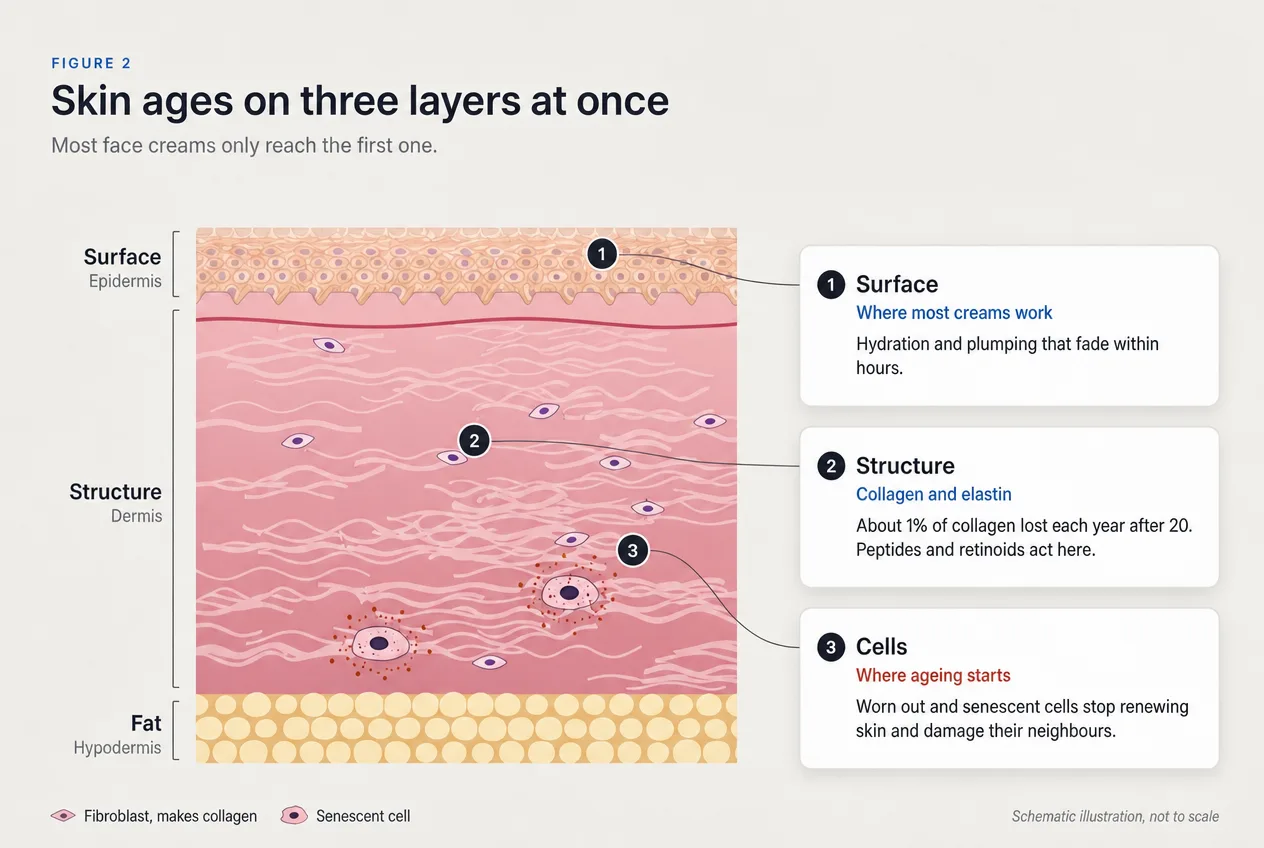
Layer 1, The Surface: Why Most Creams Never Get Past The Door
The outer layer of your skin is a barrier, built to keep things out. And it is very good at its job.
In 2000, two Dutch scientists, Jan Bos and Marcel Meinardi, showed in Experimental Dermatology that a molecule generally needs to weigh less than 500 Daltons to pass through healthy skin.² Dermatologists still call it the 500 Dalton rule.
Small molecules like vitamin C (176 Daltons) and retinol (286 Daltons) can get in. But many of the best-known ingredients in face creams are far heavier.
A single collagen molecule weighs around 300,000 Daltons. The most common form of hyaluronic acid in creams can weigh more than 1,000,000.
Expecting them to rebuild your skin is like trying to push a basketball through a keyhole. They sit on top, smooth the surface for a few hours, and come off on your pillowcase.
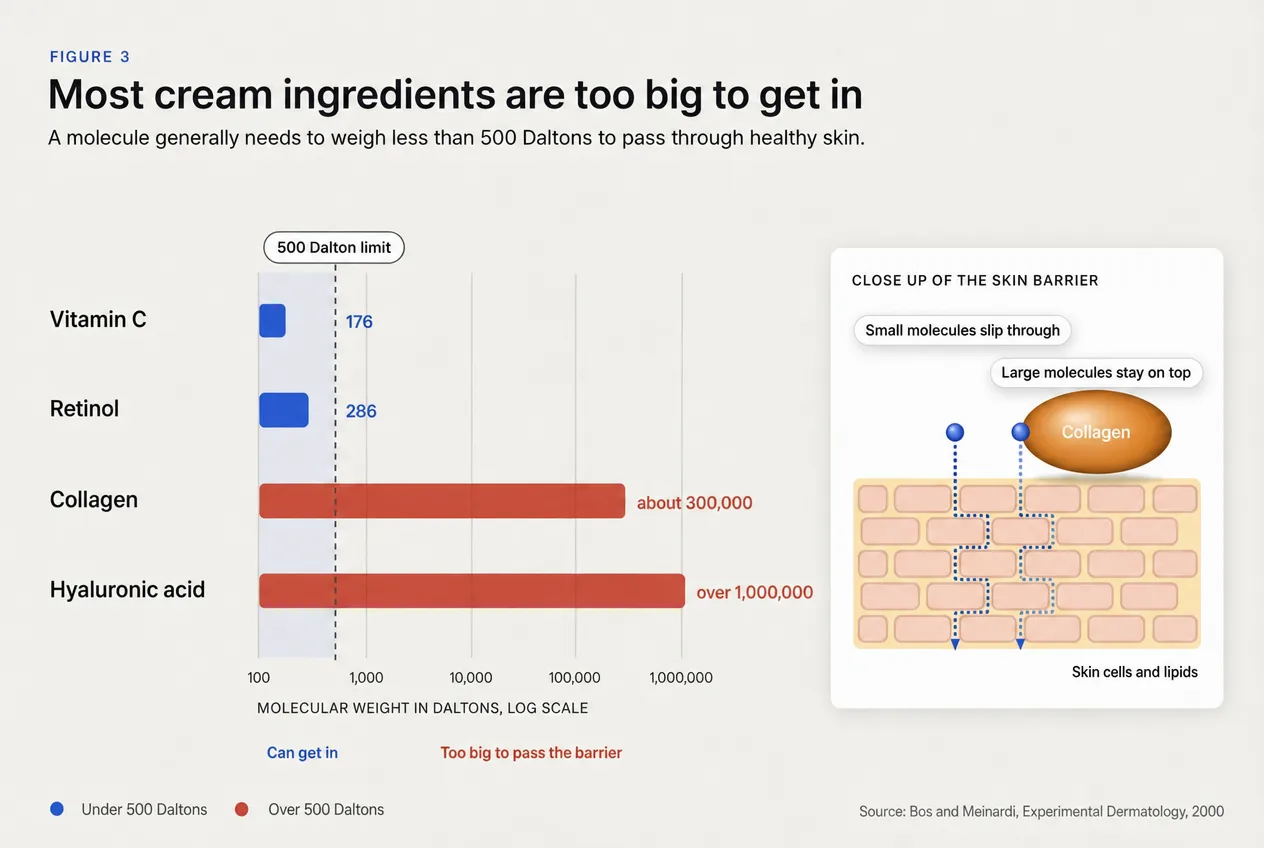
That is why these creams make skin look better for a day and no longer. Stop using them and the improvement disappears, because nothing underneath has changed.
Layer 2, The Structure: Where Firmness Is Lost, And Can Be Rebuilt
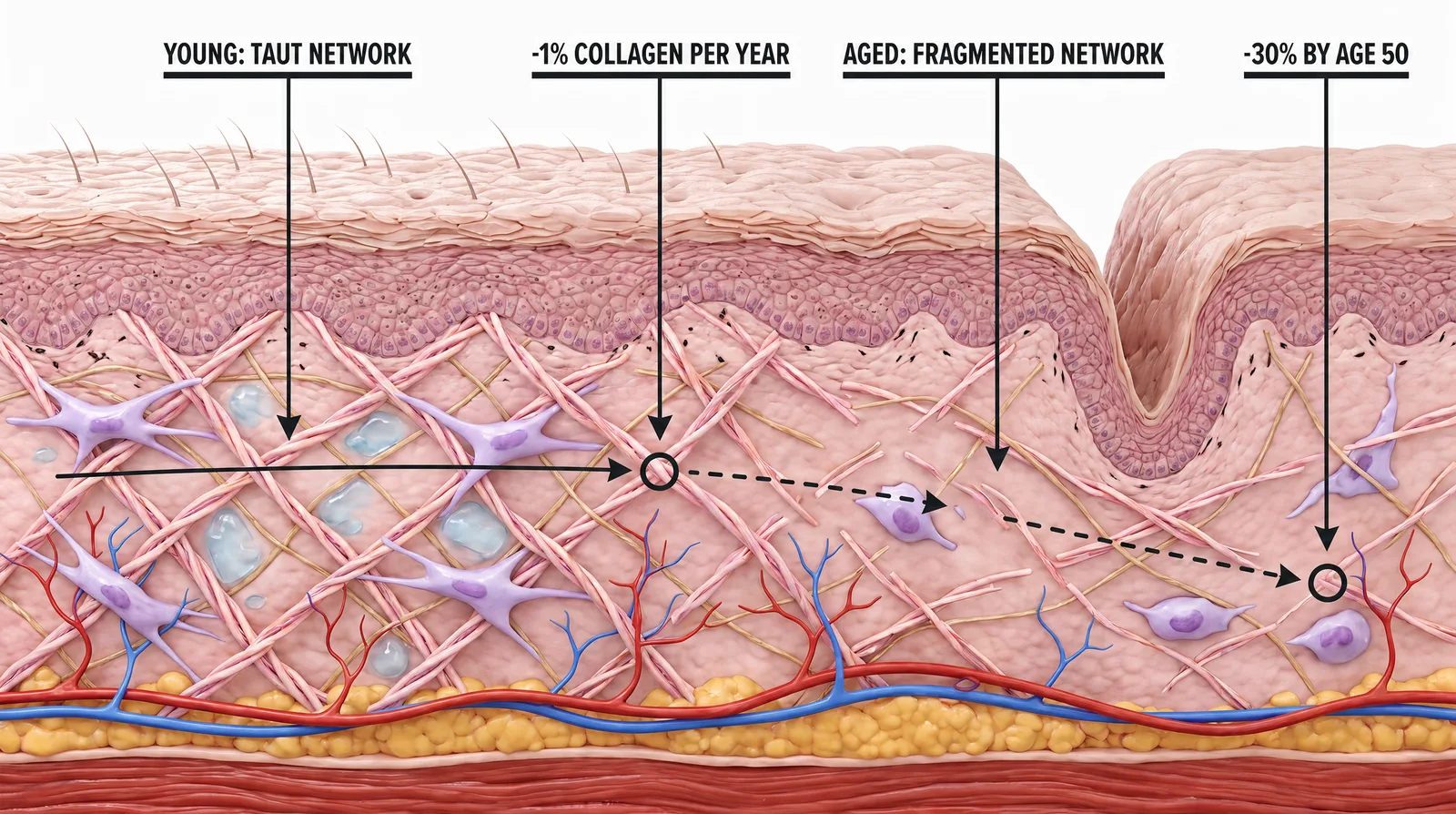
Beneath the surface sits the dermis, the thick layer that holds your face up. It is built from collagen fibres.
You lose about 1% of your collagen every year after the age of 20.³ By 50, that adds up to around 30% of the scaffolding under your face.
Researchers at the University of Michigan found what makes this loss speed up. In young skin, fibroblasts, the cells that make your collagen, are stretched tight against a strong collagen network, and that tension keeps them producing.
In older skin, that network breaks into fragments. The fibroblasts lose their grip, shrink and make far less collagen.⁴ Think of a tent whose ropes have been cut: the fabric is all still there, but it sags.
This is the layer where peptides and retinoids work. They can signal fibroblasts to make more collagen, and they work reasonably well.
But they have a ceiling, because a signal only works on a cell that can still answer it.
Layer 3, The Cells: Where Ageing Actually Starts
This is where the real story is. Every skin cell carries a clock.
Each time a cell divides, the caps on the ends of its chromosomes, called telomeres, get a little shorter.⁶ Think of the plastic tip of a shoelace, wearing down a bit more every time you tie it.
When the caps get too short, the cell stops dividing for good. This discovery earned Elizabeth Blackburn and her colleagues the 2009 Nobel Prize in Physiology or Medicine.⁷
That is why older skin renews itself more slowly: about 40 days or more, instead of 28.⁵
The worn-out cells don’t disappear. They stay in your skin and send out inflammatory signals that damage the healthy cells around them.⁸ Researchers call them senescent cells.
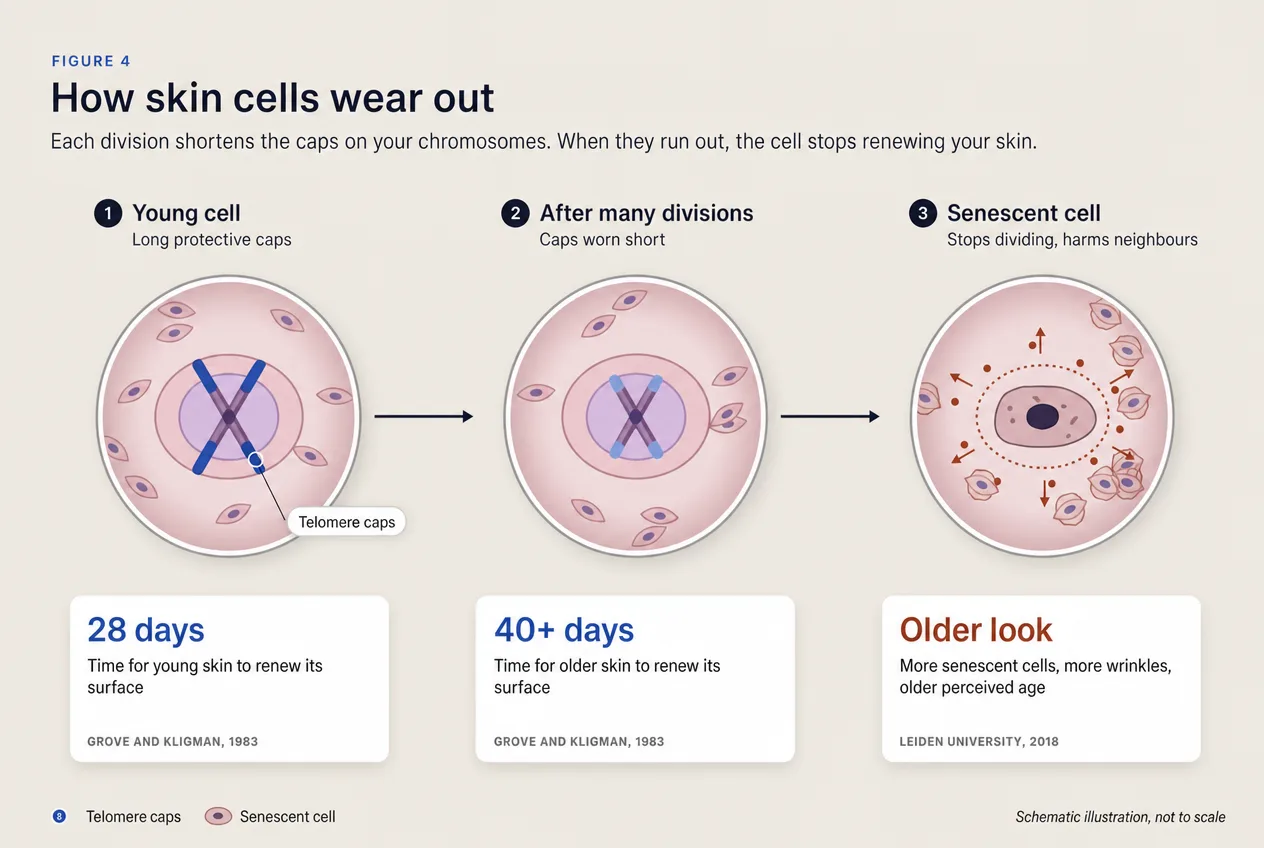
And they show on your face. At Leiden University Medical Center, people with more senescent cells in their skin had more wrinkles and were judged to look older.⁹
When Mayo Clinic researchers cleared these cells in mice, in a study published in Nature, age-related decline in their tissues was delayed.¹⁰
“You can moisturise the surface every day for 20 years and never touch these cells,” says Professor Weber.
That is why surface creams only bring temporary relief, and why good peptide creams eventually stop improving. They keep signalling cells that are too worn out to answer.
Why Most Face Creams Are Designed To Fail
Before revealing the top five, you need to understand why 122 other products failed the testing protocol.
I spoke with a cosmetic chemist who spent 15 years formulating products for major international beauty brands. He wouldn’t let me use his real name, but what he described made my stomach turn.
“Everyone in the lab knows the active ingredients are in there at concentrations too low to do anything,” he said. “The label says vitamin C, the label says peptides. But the dose is a fraction of what the research used.”
“It’s on the label, but too weak to work in real life. And the customer can’t measure that in her bathroom.”
He continued: “If a cream actually rebuilt your skin, you’d buy a few jars and stop. But a cream that just feels nice, with a little glow that fades by evening, she’ll repurchase every month for the rest of her life.”
“I’ve sat in meetings where executives called it ‘hope in a jar.’ Because results are subjective, when nothing changes, the customer blames herself. She never suspects the product was built to do almost nothing.”
He isn’t exaggerating. Take vitamin C, one of the most researched ingredients in dermatology.
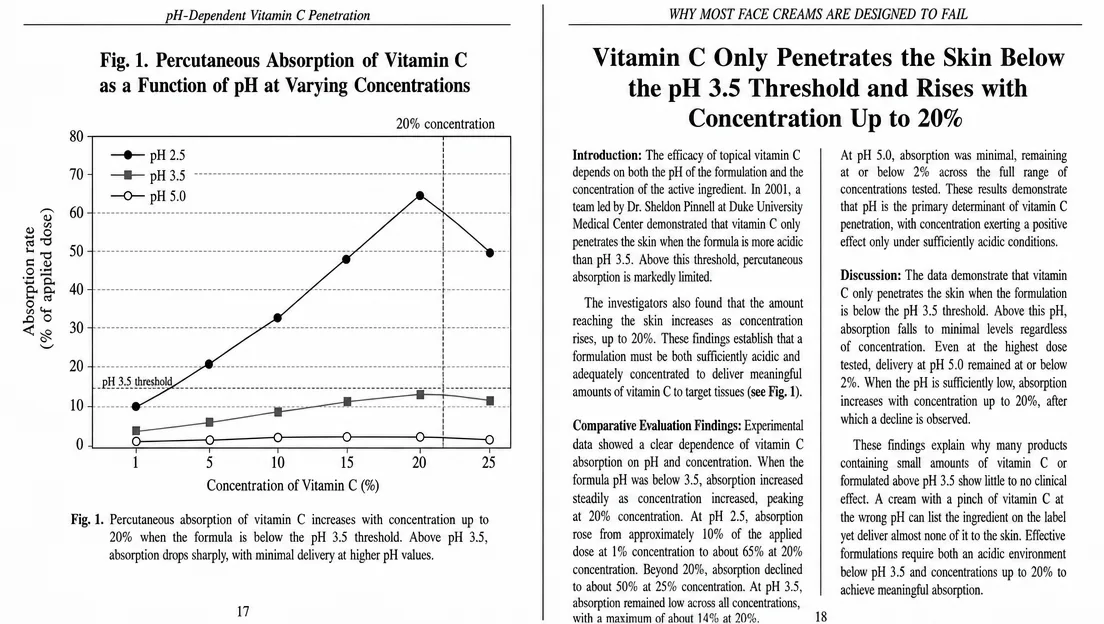
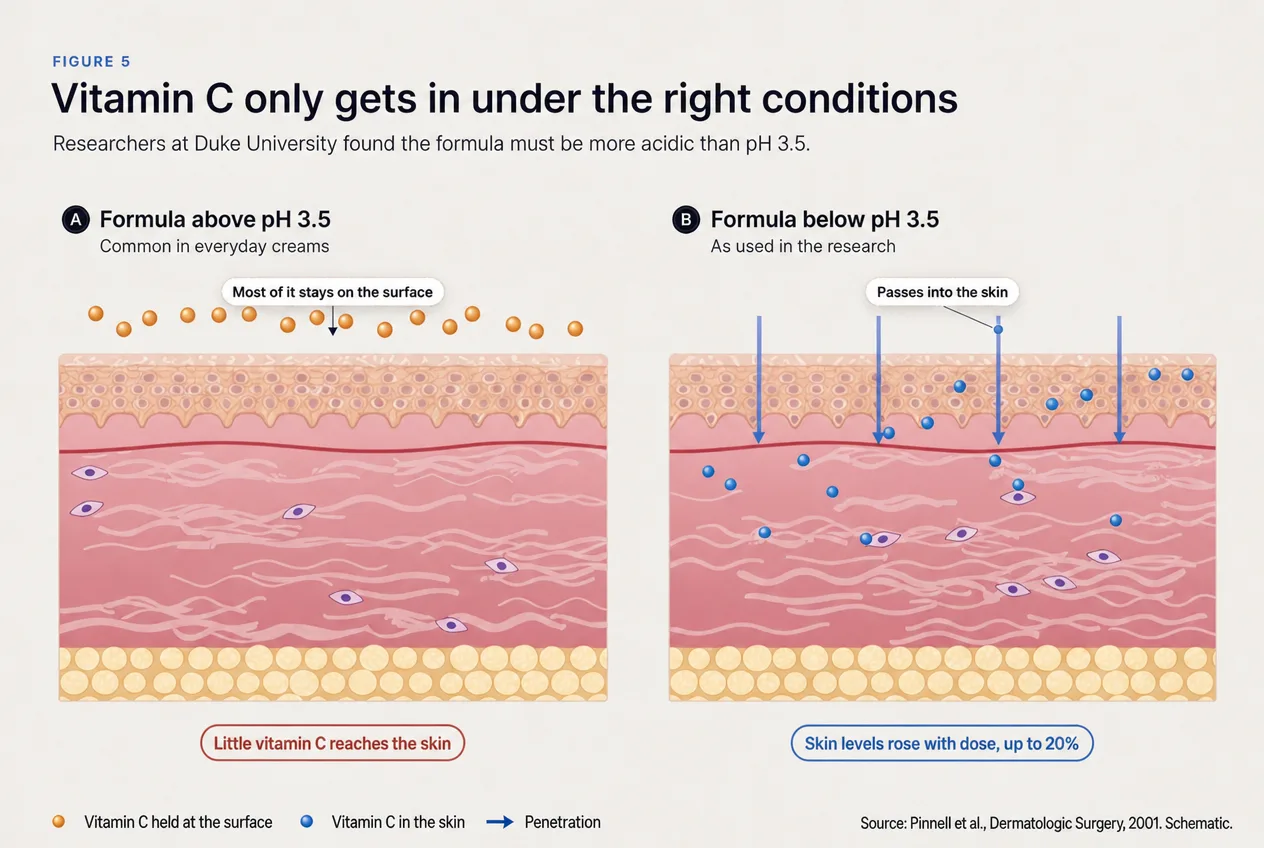
In 2001, a team led by Dr. Sheldon Pinnell at Duke University Medical Center showed that vitamin C only gets into the skin when the formula is more acidic than pH 3.5.¹¹ Above that, it barely gets in.
They also found that the amount reaching the skin kept rising with concentration, up to 20%.¹¹ A cream with a pinch of vitamin C at the wrong pH can print it on the label and deliver almost none of it.
The testing exposed exactly this pattern. Most of the products contained their actives at subclinical concentrations: present on the label, too weak to work. Even premium-priced brands often showed limited effect.
“That’s why women try product after product and see no lasting results,” one reviewing dermatologist noted. “It was never the woman’s fault. The formula was never built to reach where ageing happens.“
The five products that ranked highest all did something the other 122 couldn’t. They worked below the surface, at concentrations strong enough to change how skin behaves.
Our Scientific Review Board For This Study
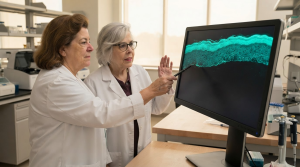
All findings were reviewed by a panel of three specialists: Professor Charlotte Weber, MD, Marcus Bauer, PhD, and Laura Schmidt, MD, FRCP.
“Our role was to check that the testing protocol met academic standards and that every claim could be traced back to a documented measurement,” says Professor Weber. “No manufacturer had any input into the evaluation criteria or the results.”
The Independent Testing Protocol
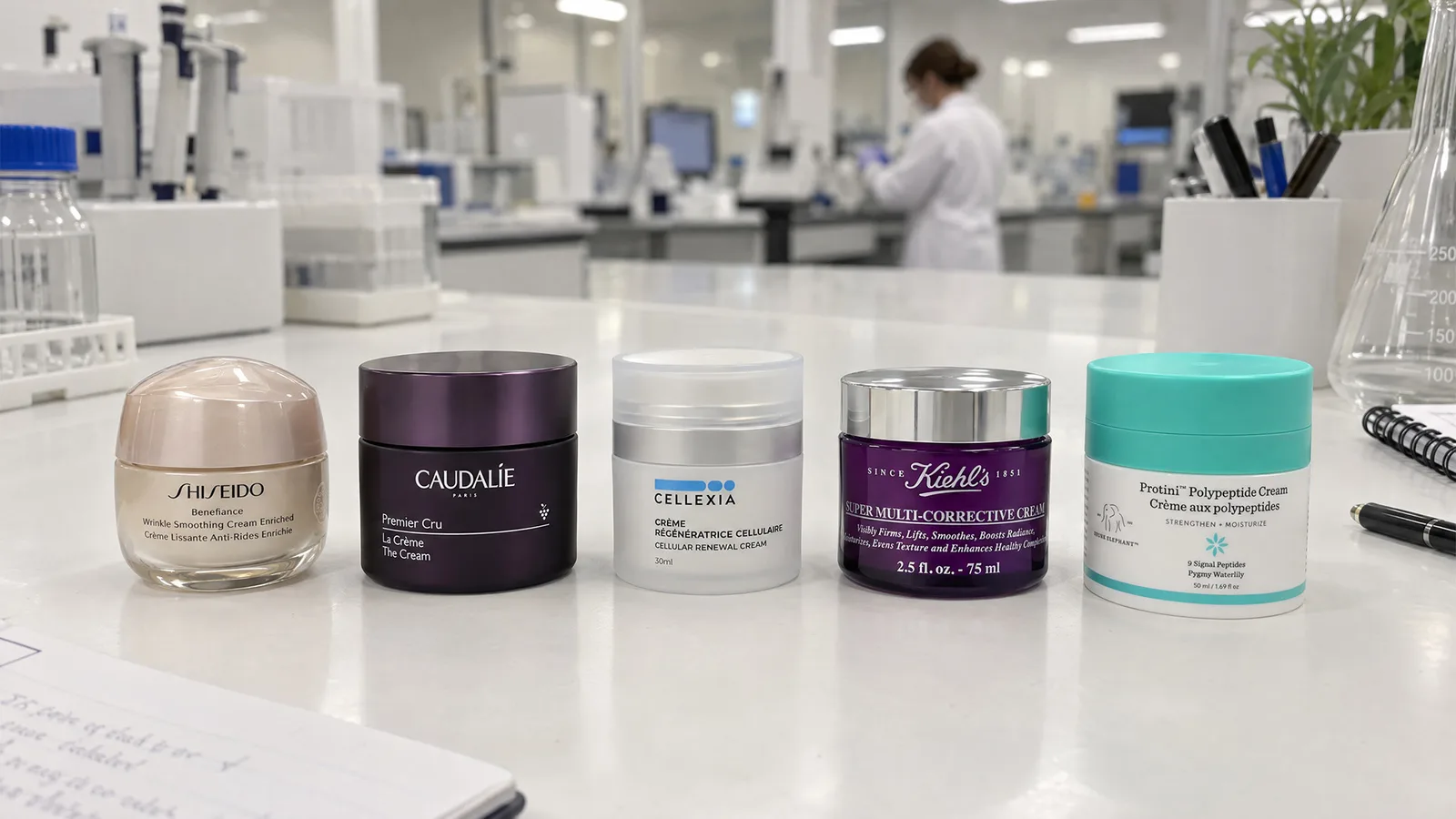
Each product was analysed with a 12-point evaluation system that measured how skin both looked and functioned:
- Active ingredient concentration: verified in the laboratory to confirm the dose was strong enough to work
- Collagen production: tested directly in skin samples to measure structural rebuilding
- Wrinkle depth reduction: quantified with profilometry and 3D skin scanning under standardised lighting
- Skin elasticity and firmness: tracked with Cutometer R2 readings over the full testing window
- Skin hydration: measured with Corneometer readings over 24 hours and across 12 weeks
- Barrier function: assessed through TEWL (trans-epidermal water loss) to track how well skin holds moisture
- Pigmentation: monitored with Mexameter melanin-index readings for tone and radiance
- Cellular renewal markers: tracked to see whether the formula changed how skin behaves, not just how it looks
- Clinical photography: before and after images captured under identical lighting
- Dermatological compatibility: irritation and allergy testing on sensitive skin
- Application properties: absorption rate, non-greasy feel and make-up compatibility
- Progress over time: measurements at weeks 4, 8 and 12 to separate quick plumping from real change
All products were purchased anonymously from retail sources. Testing followed standardised protocols under DIN EN ISO 22716 for full reproducibility.
Key Study Findings

Concentration Is Binary: Either An Ingredient Is Dosed To Work, Or It Isn’t
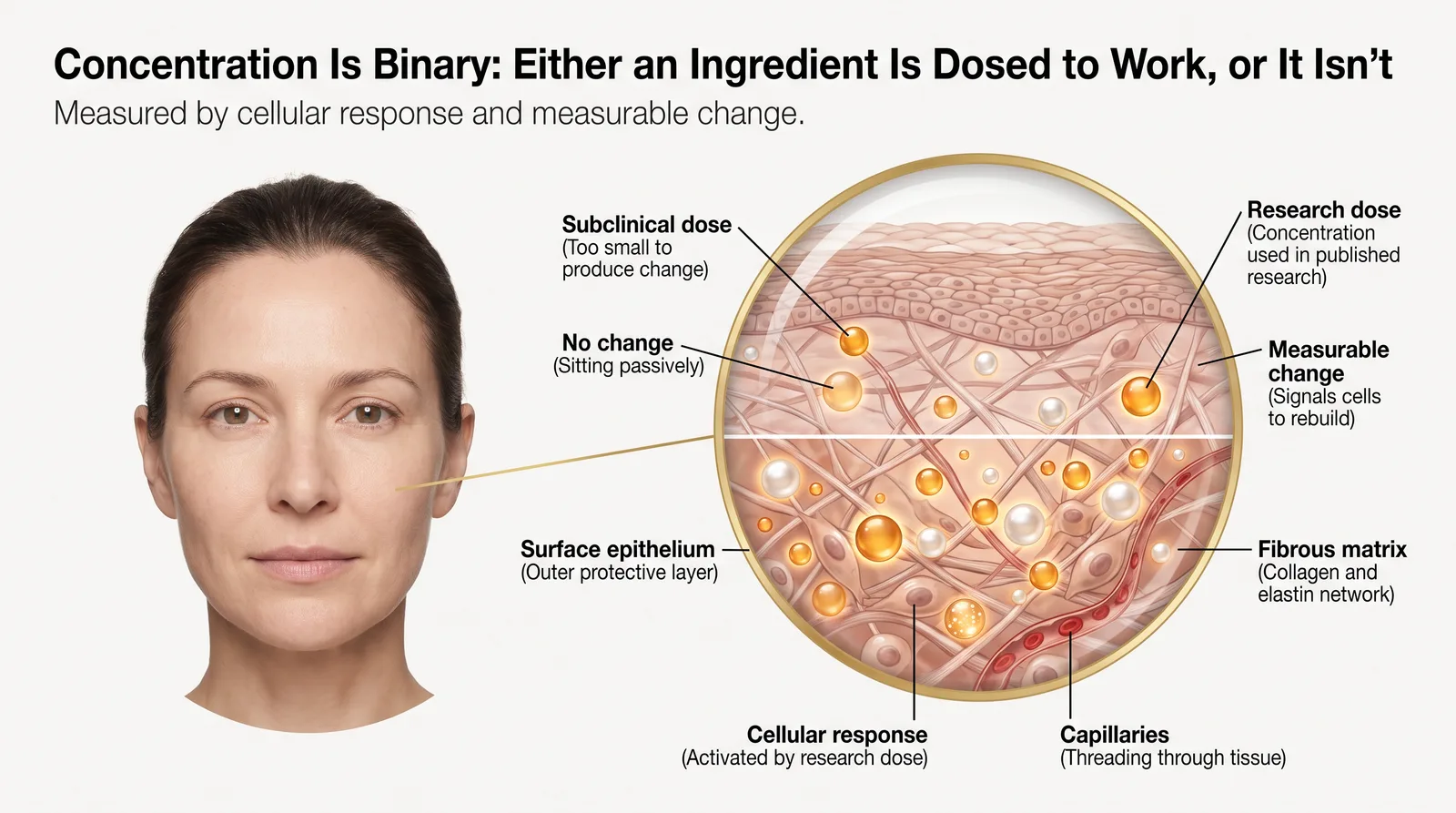
Most products contained their actives at subclinical concentrations, listed on the label but too small to produce any measurable change.
A handful contained the same actives at the doses used in the published research. Those were the creams that changed how skin behaved.
“This isn’t a difference of degree, it’s a difference of kind,” explains Dr. Bauer. “It’s the difference between a cream that signals your cells to rebuild and one that sits on the surface until you wash it off.”
Ingredients Work Better Together Than Alone
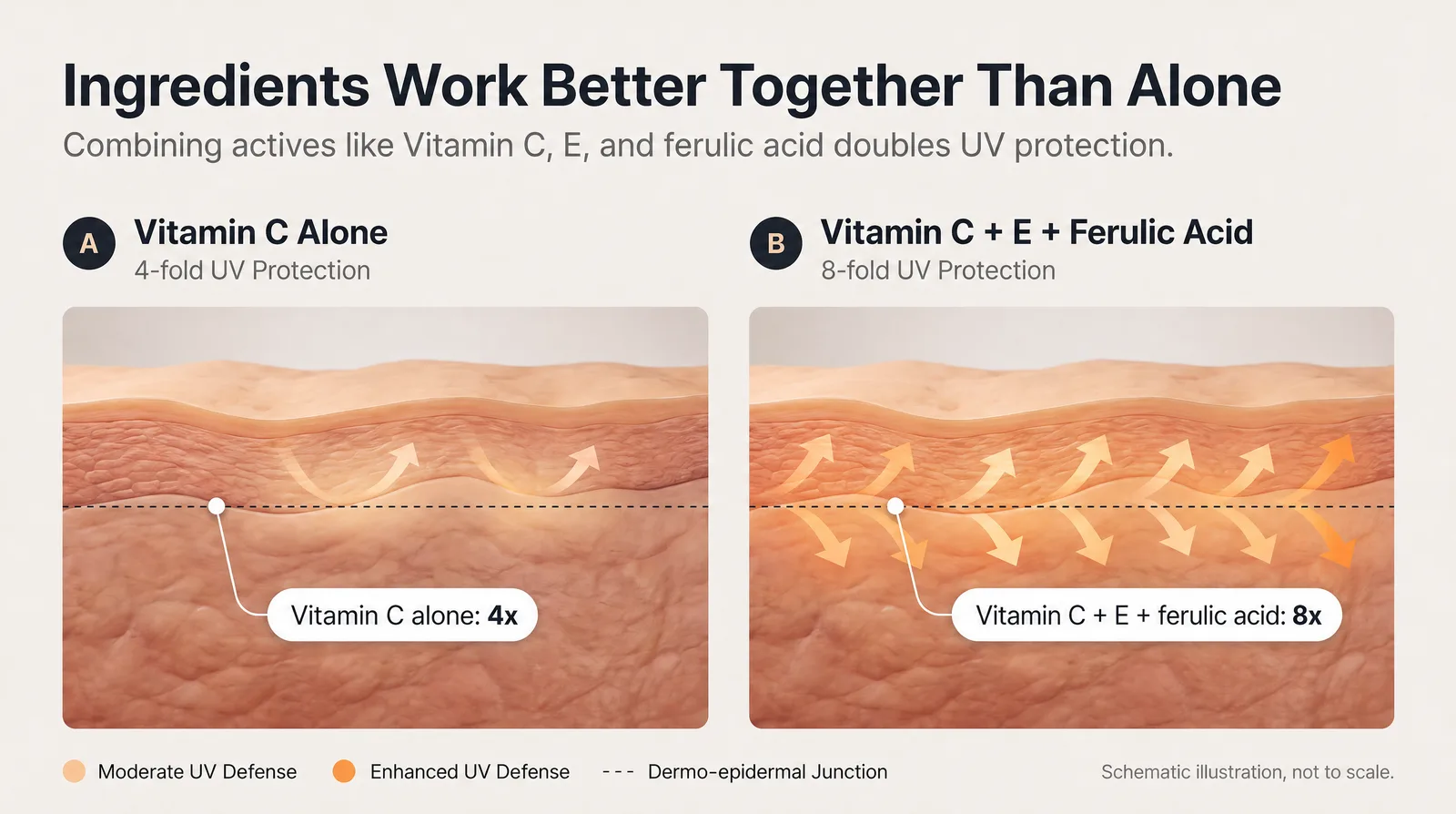
No product built around a single hero ingredient reached the top results, however strong that one ingredient was.
Vitamin C shows why. In a study published in the Journal of Investigative Dermatology, adding vitamin E and ferulic acid kept vitamin C stable and doubled its protection of skin against UV damage, from about 4-fold to about 8-fold.¹²
“Ageing is several problems stacked on top of each other,” says Professor Weber. “A surface that has lost moisture, a structure that has lost collagen, and cells that have slowed down. Fix one and the other two pull the skin right back.“
The most effective creams in the test contained four to six complementary actives working together.
The Week-8 Wall: Why Most Creams Stop Working After Two Months
The real separation between creams showed up after week 8. Most people don’t have their first true “this is working” moment until weeks 6 to 8.
That is exactly when many women give up on a cream and move on to the next one.
“We saw the same pattern again and again,” explains Dr. Bauer. “Hydration improves in weeks 1 to 2. Texture changes in weeks 3 to 4. Firmness becomes visible in photographs in weeks 6 to 8. From there, surface creams plateau, while creams working at the cellular level keep improving.“
The numbers make the wall easy to see. Between week 8 and week 12, four of the five top creams gained between 0,2 and 1,7 points of wrinkle reduction.
The top-ranked cream gained 7,8 points in the same four weeks, more than the other four combined.
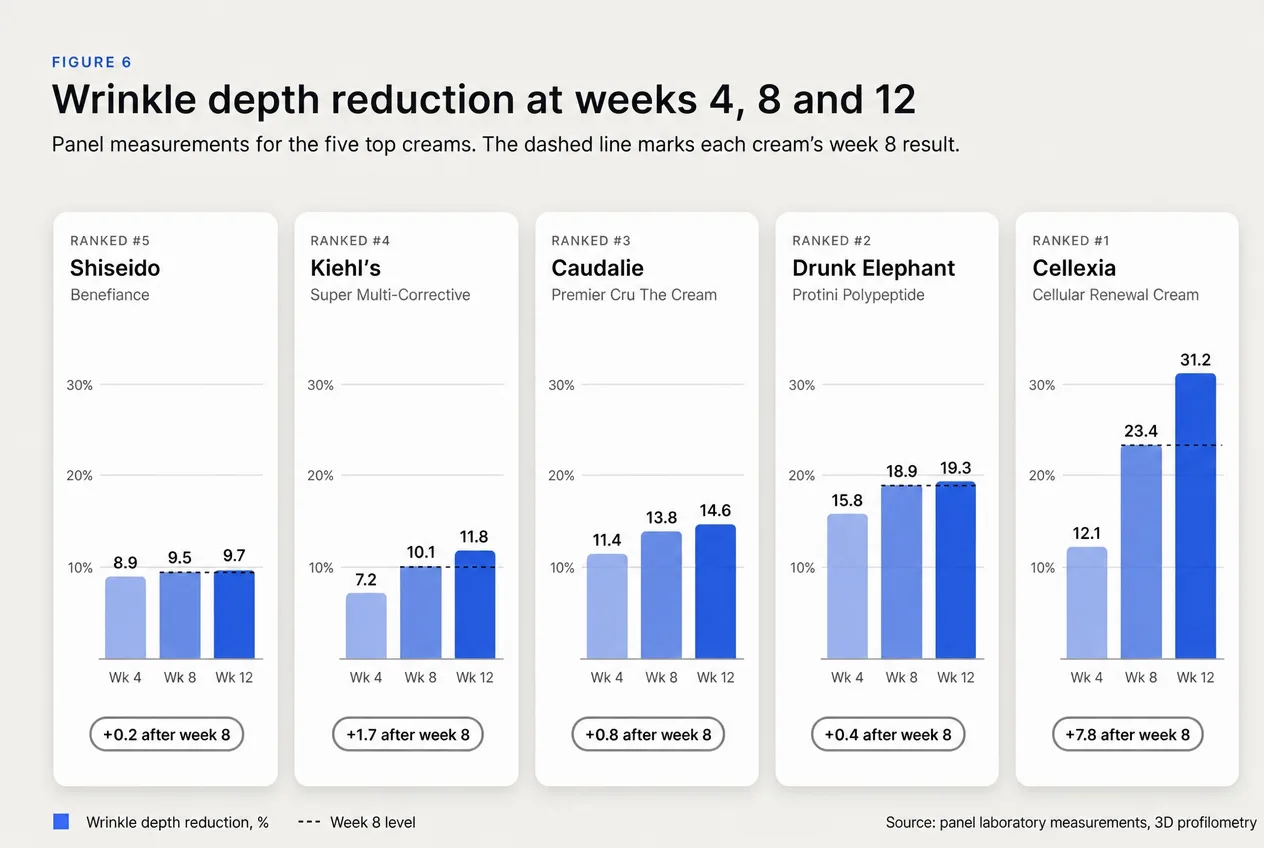
The reason is the layer each cream works on. A cream that hydrates or signals collagen can only push your existing cells to work as well as they can.
Once they reach that limit, results stop, because the cells themselves are still old. Only a cream that changes the cells can keep improving past that point.
The 4 Active Mechanisms That Change How Skin Behaves
Analysis of the top performers revealed four mechanisms that consistently delivered results. Each one reaches a deeper layer than a standard moisturiser ever could, and the last two reach the deepest layer of all.
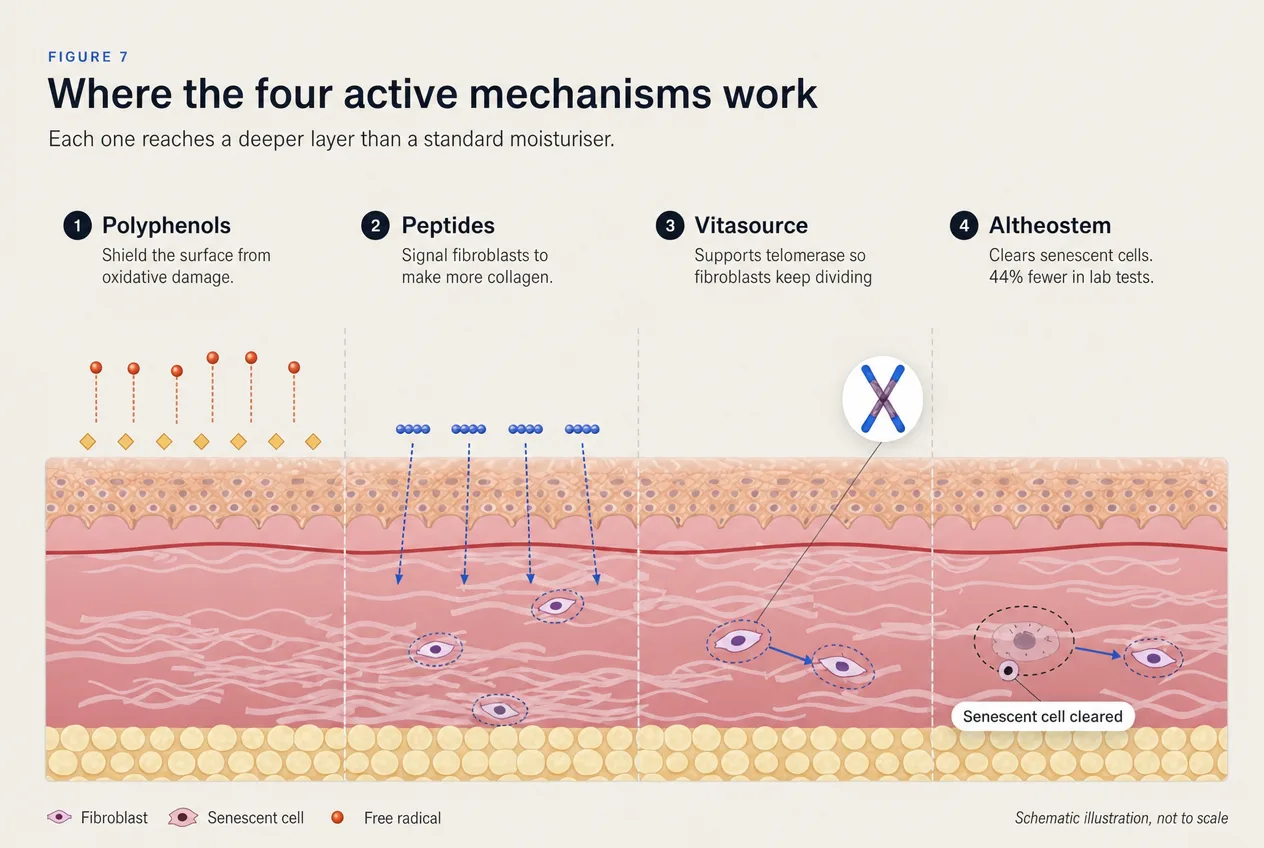
1. Antioxidant Polyphenols: Protection Against Daily Damage
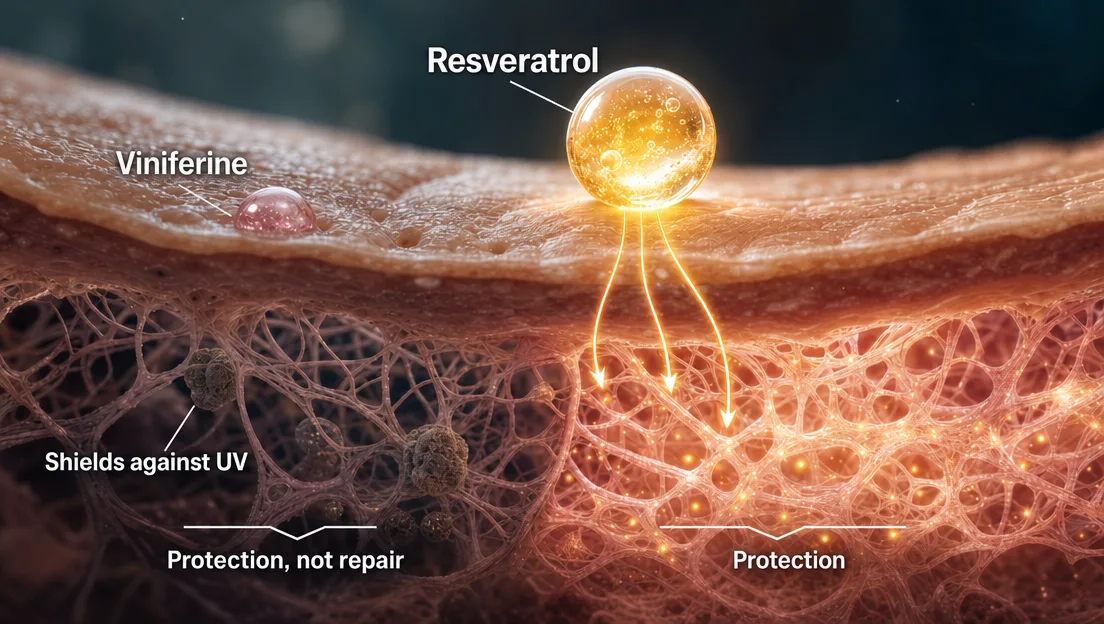
Resveratrol, viniferine and other grape-derived polyphenols shield skin from pollution, UV exposure and oxidative stress, which quietly speed up collagen breakdown every day.¹⁴
Several creams in the top five use them, and they earn their place.
“This is protection rather than repair,” says Dr. Schmidt. “It stops further damage, which matters, but on its own it won’t undo lines that have already formed.”
2. Peptide Complexes: Rebuilding The Structure
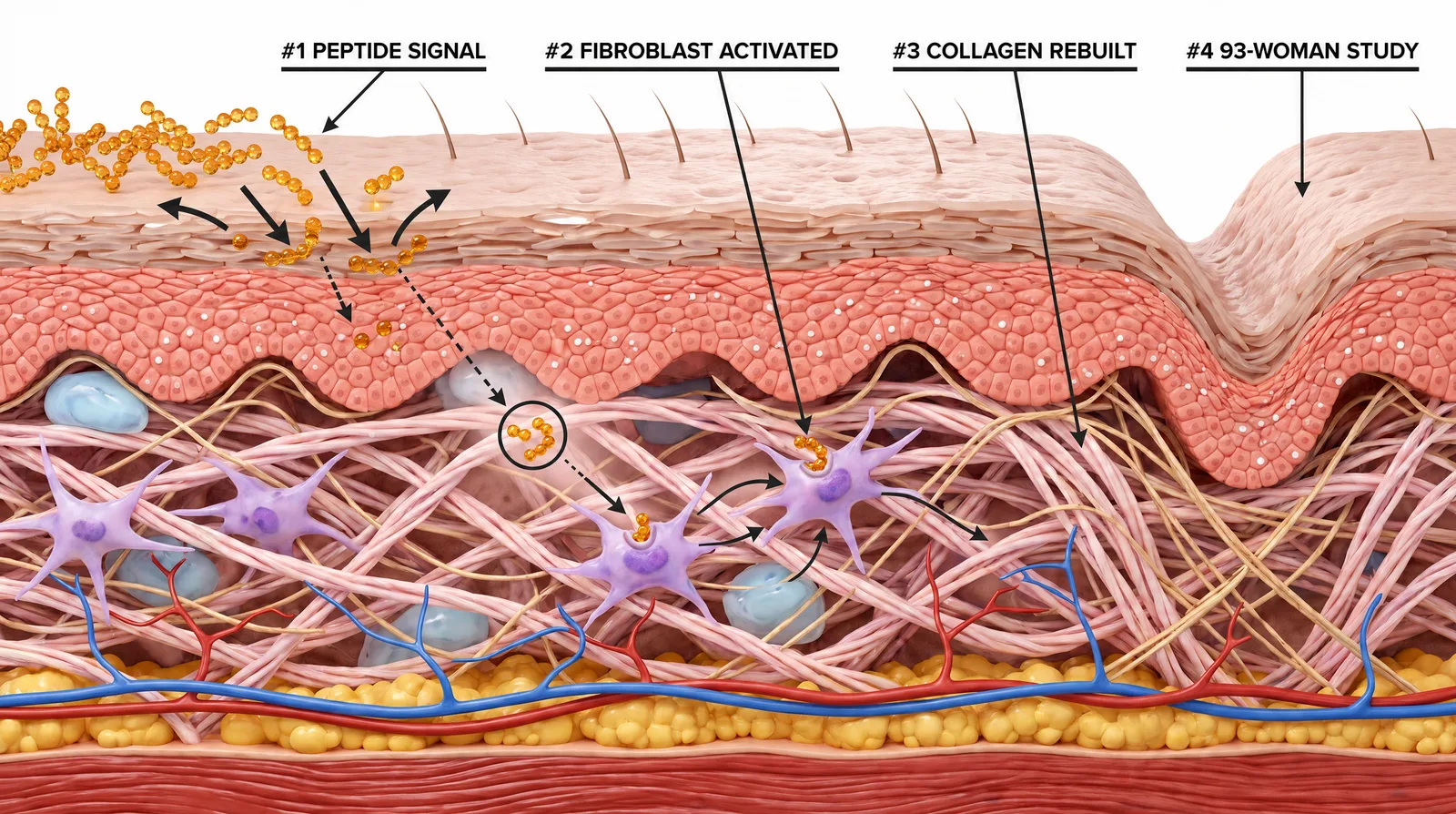
Peptides are short chains of amino acids that act as messages to your fibroblasts. They tell them to rebuild the collagen and elastin scaffolding that holds skin up from beneath.
They are among the best-studied actives in skincare. In a 12-week, placebo-controlled study of 93 women, a cream with palmitoyl pentapeptide significantly improved wrinkles and fine lines compared with the placebo.¹³
“Think of collagen as the support beams under your skin,” explains Dr. Schmidt. “When they thin, the surface caves inward and a wrinkle forms. Rebuild the beams and the skin lifts back into place.“
Peptides have one limit: they can only ask cells to work harder. They cannot make old cells younger, which is why peptide creams tend to start fast and then level off.
3. Vitasource: Telomerase Activation
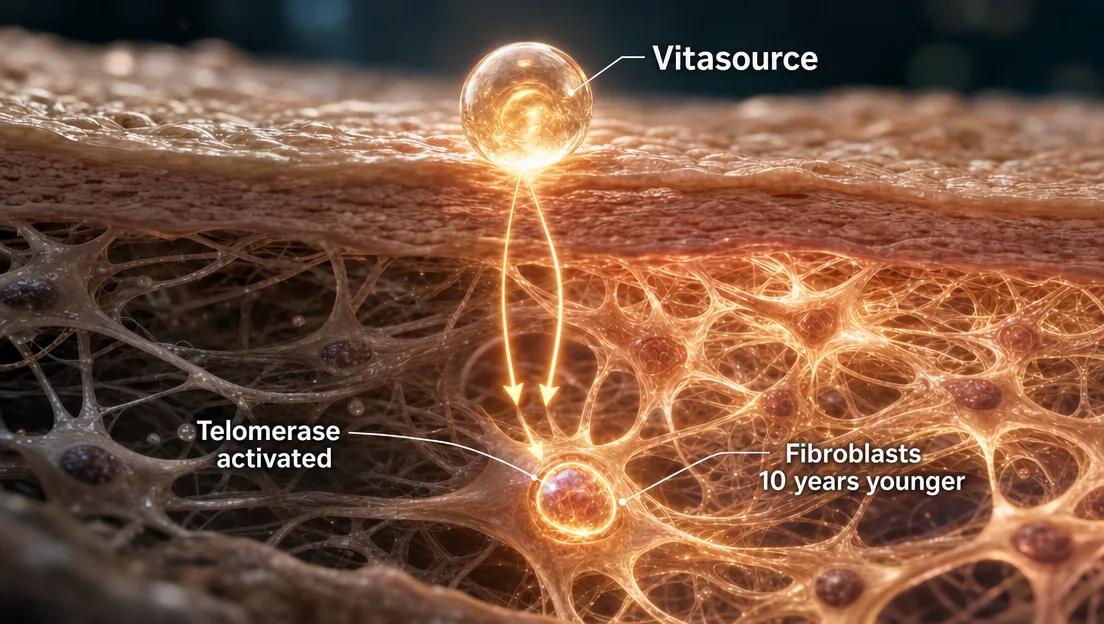
Remember the shoelace tips on your chromosomes. Vitasource enhances telomerase, the enzyme that helps maintain those caps, the same enzyme recognised by the 2009 Nobel Prize.⁷ ¹⁵
The result: fibroblasts, the cells that make your collagen, replicated as if they were 10 years younger in laboratory testing.¹⁵ More active fibroblasts means more collagen, and firmer, more elastic skin.
“This is a change in how the cell behaves, not a surface trick,” explains Dr. Bauer. “Instead of asking a tired cell to work harder, you restore its ability to renew itself.”
4. Altheostem: Clearing Out Worn-Out Cells
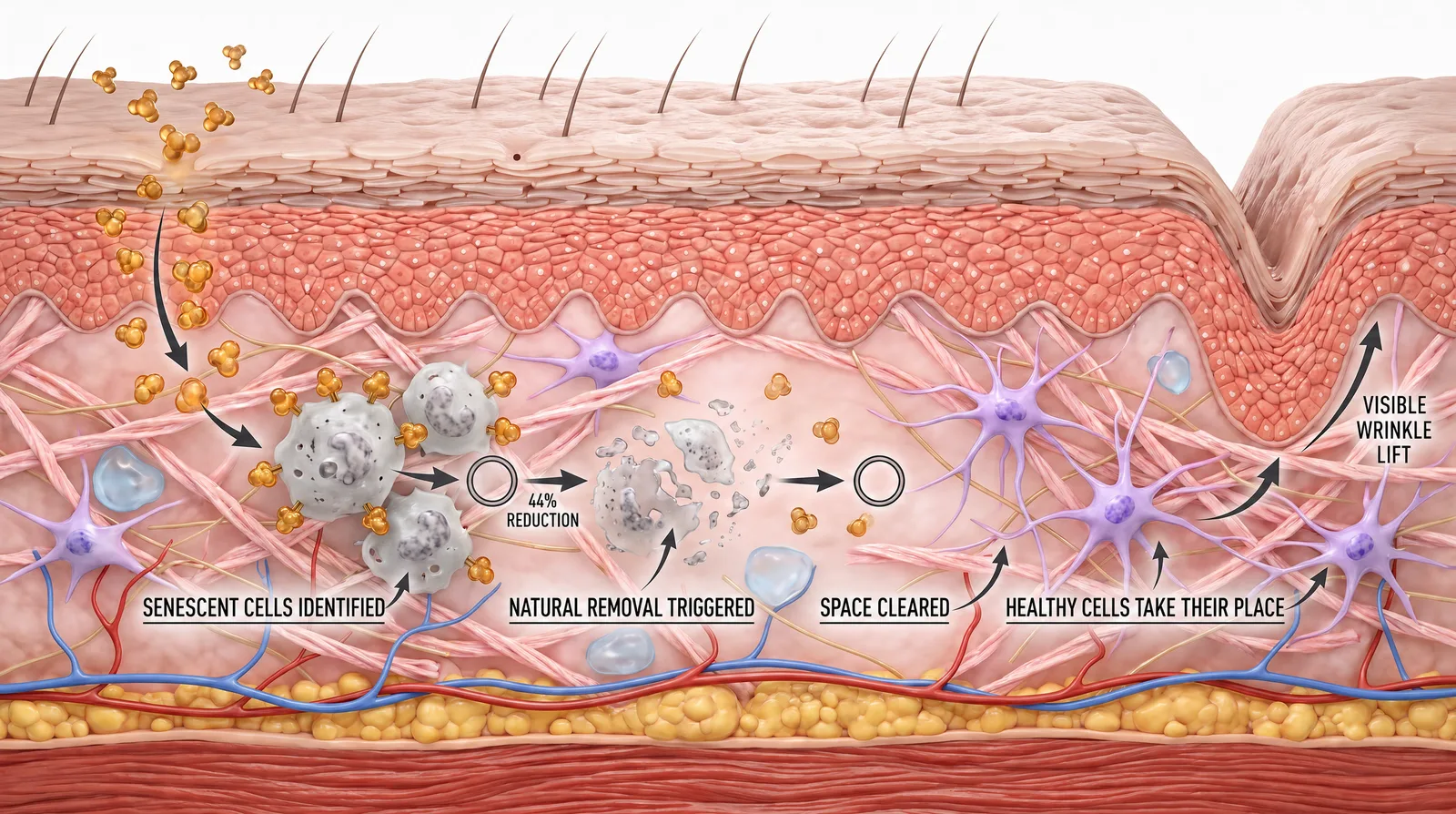
Altheostem, from the hollyhock plant (Althaea rosea), targets the senescent cells the Leiden researchers linked to deeper wrinkles and an older-looking face.
It triggers the natural removal of these cells, clearing space for healthy ones to take their place. In laboratory testing, Altheostem reduced senescent cells by 44%.¹⁵
After 8 weeks of use, participants were judged up to 3.26 years younger across the full face, and up to 5.7 years younger around the eyes, where skin is thinnest.¹⁵
3 Questions That Tell You If A Cream Can Work Below The Surface
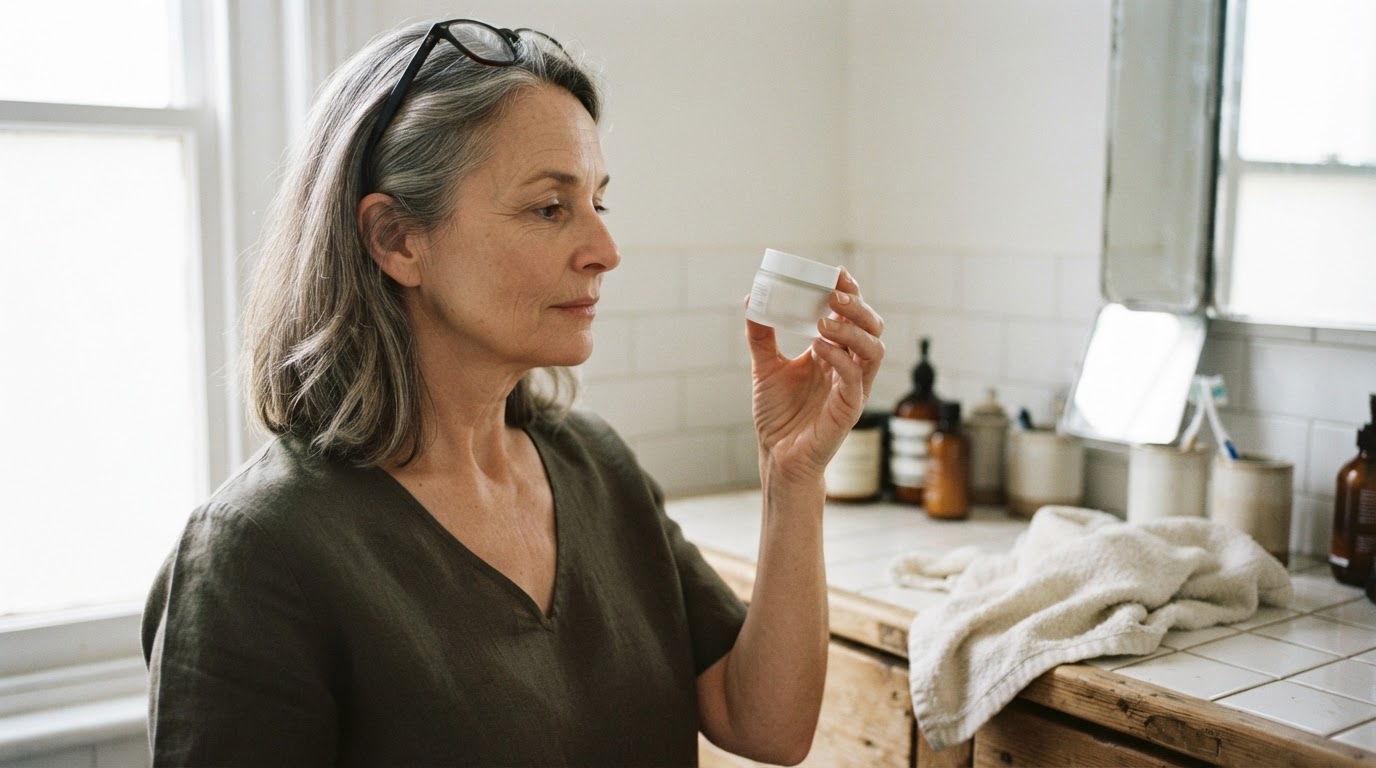
Before you buy your next face cream, ask it three questions. They are the same ones the panel used to separate the 5 creams that passed from the 122 that did not.
- Are its actives dosed at the level used in the research? A name on the ingredient list means nothing without the dose behind it.
- Does it reach the cells, or only the surface and the structure? Hydration and collagen signals help, but the deepest layer decides how long results last.
- Does it have data showing results still improving after week 8? Any decent cream can look good at week. The week-8 wall shows what it really does.
“Most women choose a cream by its brand or its price,” says Professor Weber. “Dermatologists choose on data. These three questions are how you choose like one.”
Each of the five creams below earned its place for a different strength. Here is how they compare.
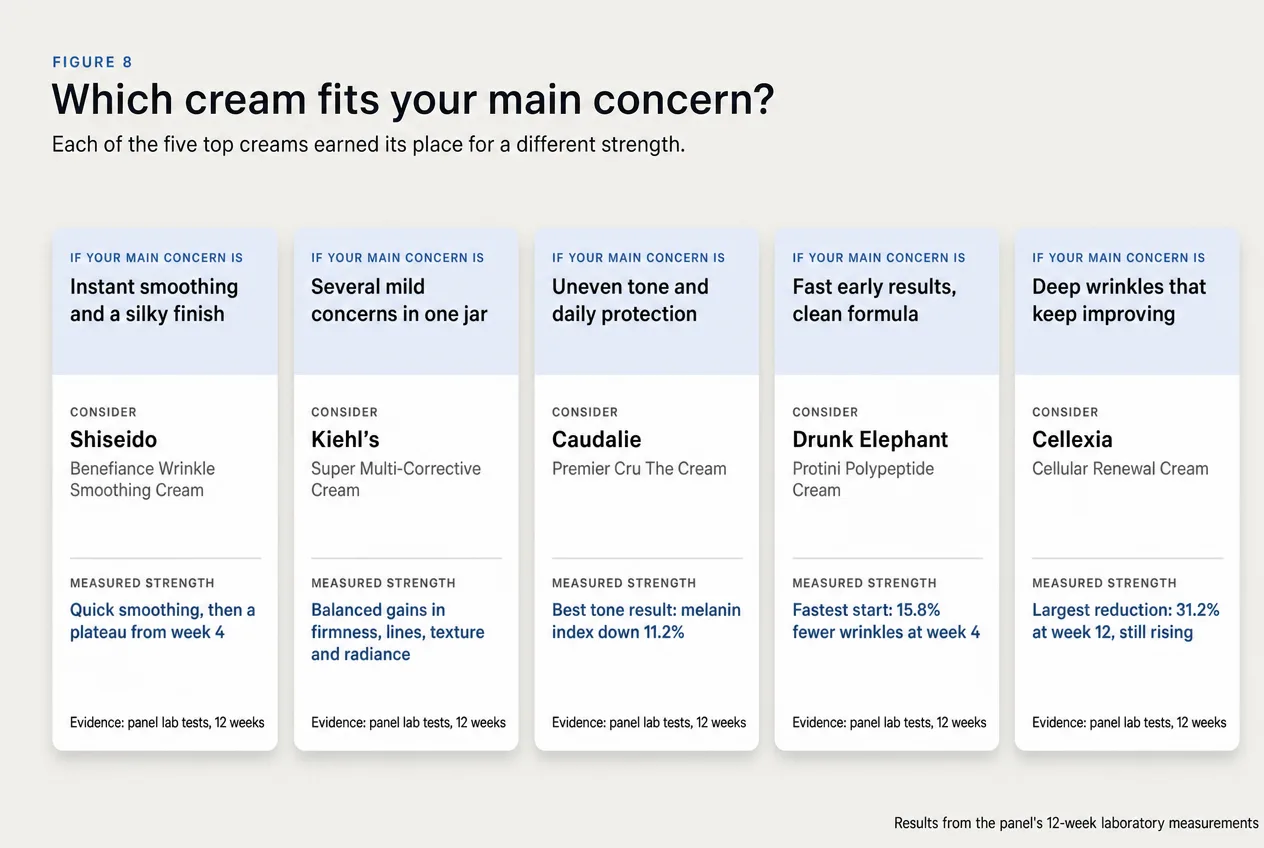
The Complete Rankings: The 5 Most Effective Face Creams Based On Laboratory Data
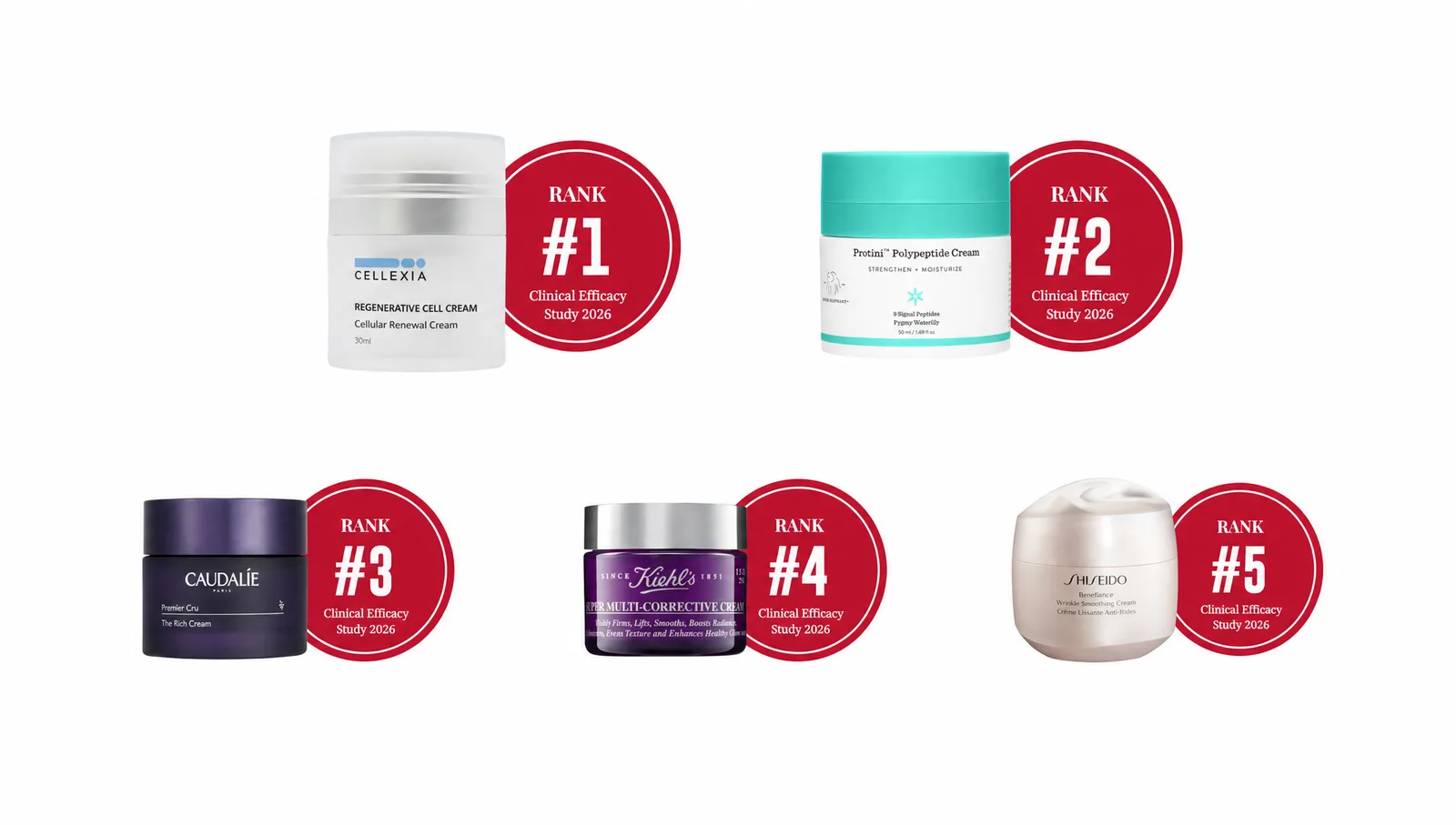
The final ranking combined active-concentration verification, profilometry wrinkle-depth measurements, Cutometer firmness readings, Corneometer hydration analysis, TEWL barrier readings, Mexameter pigmentation data, dermatologist assessments and 12 weeks of user tracking.
Products were scored out of 100. Only five reached the top scores.
| Rank | Product | Clinical Efficacy Score |
|---|---|---|
| 1 | Cellexia – Cellular Renewal Cream | 96/100 |
| 2 | Drunk Elephant – Protini Polypeptide Cream | 90/100 |
| 3 | Caudalie – Premier Cru The Cream | 88/100 |
| 4 | Kiehl’s – Super Multi-Corrective Cream | 86/100 |
| 5 | Shiseido – Benefiance Wrinkle Smoothing Cream | 84/100 |
1. Cellexia – Cellular Renewal Cream
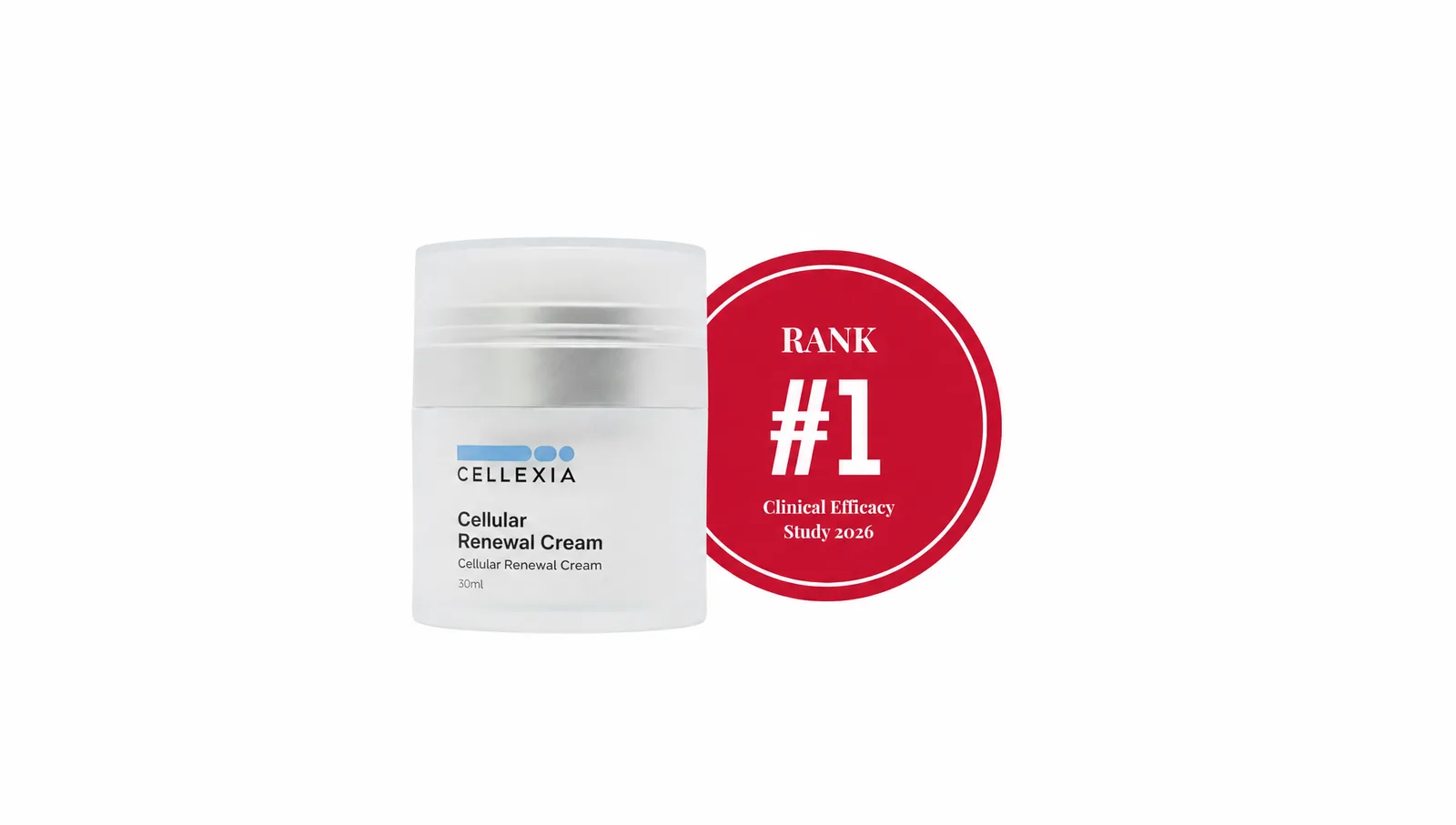
Clinical Efficacy Score: 96/100
Exceptional cellular engineering: Of all 127 products tested, this was the only formula that worked on all three layers of ageing at once, including the cellular layer almost no other cream reaches.
It also did something none of the others did: it kept improving. Between week 8 and week 12, the other four creams gained between 0.2 and 1.7 points. Cellexia gained 7.8, and was still climbing when the study ended.
Performance measured in the study:
- Wrinkle depth: 31.2% reduction at week 12 (highest in the study, still climbing)
- Skin elasticity: R2 improved from 0.52 to 0.71 (+36.5%, highest in the study)
- Skin hydration: +28.3% at week 12 (highest in the study)
- Barrier function: 24.7% reduction in water loss
- Pigmentation: 18.4% reduction in melanin index
- Senescent cells reduced by 44% (Altheostem)
- Perceived age: up to 3.26 years younger after 8 weeks, up to 5.7 years younger around the eyes
- Wrinkle-depth timeline: week 4: 12.1%, week 8: 23.4%, week 12: 31.2% (the only cream still rising)
How it works: Cellexia works on both sides of the cellular problem. Vitasource enhances telomerase activity, so fibroblasts replicate as if they were 10 years younger and produce collagen again.
Altheostem clears out the worn-out senescent cells that block renewal, reducing them by 44%. And a squalane base takes care of the surface, raising hydration by up to 51% within 24 hours, with 95% of participants showing a measurable improvement within 5 minutes.¹⁵
Confirmed in a separate clinical study: 42 women aged 45 to 65 applied the cream twice a day for 8 weeks, with results measured by 3D imaging. Wrinkle depth around the eyes fell by 47%, elasticity improved by 39% and firmness increased by 33%.¹⁶
Dermatologists who did not know which photographs were before or after judged the women’s skin younger and firmer. And 93% of participants said their skin felt more nourished and hydrated after just two weeks.¹⁶
Documented efficacy pattern: Skin feels more hydrated within minutes, the first visible changes appear around weeks 3 to 4, and real structural improvement arrives by weeks 6 to 8.
At week 4, participants showed a 12.1% wrinkle reduction. By week 8, that had nearly doubled to 23.4%. At week 12, it reached 31.2%, still climbing.
Independent recognition: Cellexia’s technology builds on the research on telomeres recognised by the 2009 Nobel Prize in Physiology or Medicine.⁷ The cream is used in 138 aesthetic clinics, and Cellexia won the 2026 European Cosmetic Prize, awarded by a jury of 27 international experts.
Application characteristics: Absorbs within two to three minutes without residue. Suitable for most skin types, though very oily skin may find it slightly rich for daytime. Twice-daily use is needed for the results above. Not recommended during pregnancy or breastfeeding because of its high concentration of actives.
Position in the ranking: The highest-scoring formula in the testing protocol, the only product working on the surface, structural and cellular layers together, and the only one whose results were still improving when the study ended.
Availability and guarantee: Available only from the Cellexia website and in aesthetic clinics, not in retail stores, and frequently out of stock because of demand.
Every order is covered by a 60-day money-back guarantee, even on opened jars. That gives you enough time to get past the week-8 wall and judge the results for yourself.
Clinical notes: “In two decades of skin research, this is the only cream I’ve measured that kept improving past week 12,” says Professor Weber. “When you change how the cells themselves behave, the results build on each other instead of levelling off.”
“If you’re over 40 and your cream worked for a few weeks and then stopped, this is the one I would try first,” adds Dr. Schmidt. “It’s made for skin whose cells have slowed down, which is exactly the skin that has stopped responding to everything else.”
2. Drunk Elephant – Protini Polypeptide Cream
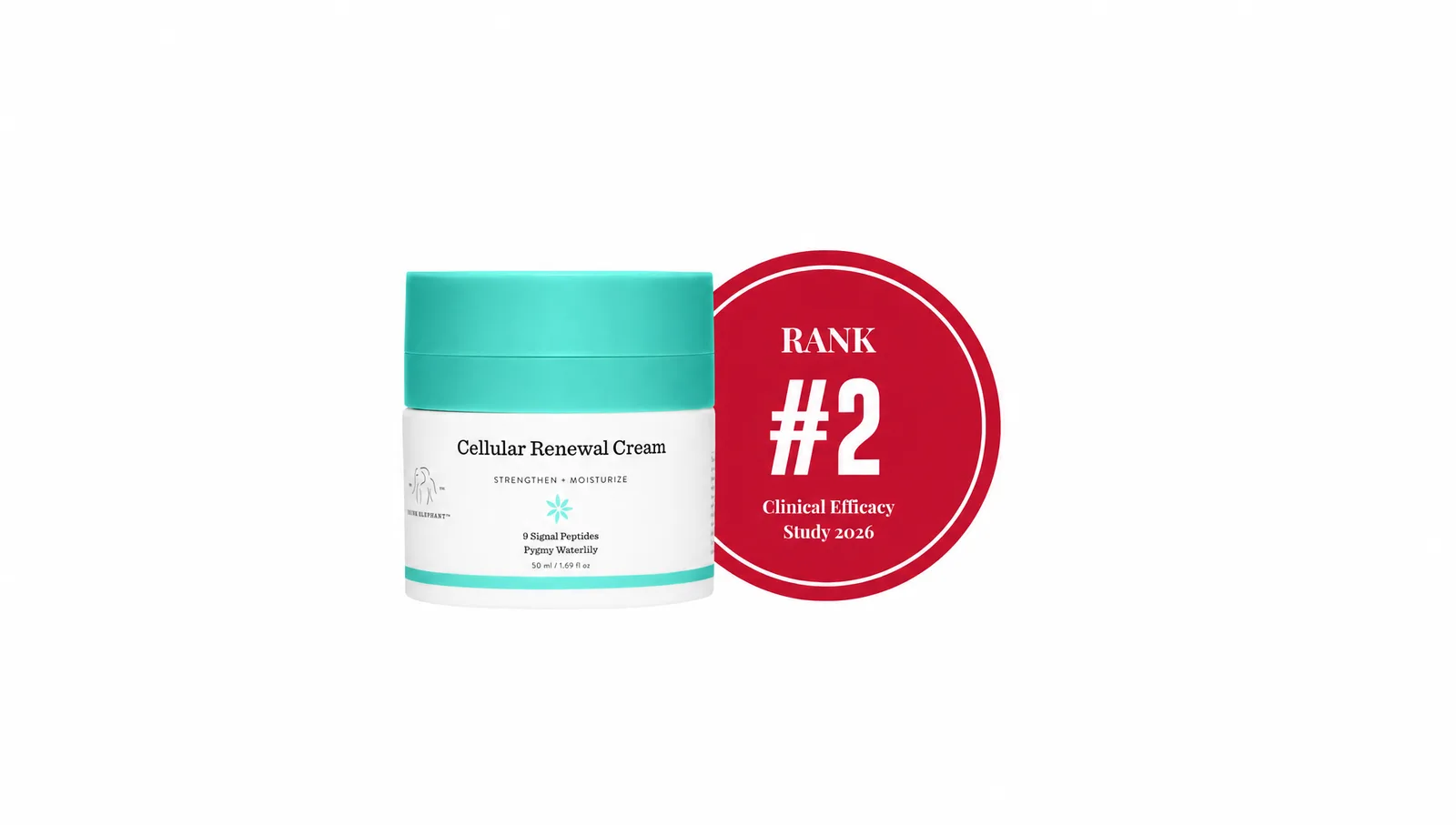
Clinical Efficacy Score: 90/100
Peptide-repair formulation: A sophisticated nine-peptide blend. Some peptides signal collagen production, others support communication between cells, and several help maintain barrier function.
This is real structural support, which is why it outperformed the top-ranked cream in the first weeks of the test.
Performance measured in the study:
- Wrinkle depth: 19.3% reduction at week 12
- Week-4 wrinkle reduction: 15.8% (ahead of the #1 cream’s 12.1% at week 4)
- Skin hydration: +24.1% at week 12
- Skin elasticity: R2 improved from 0.51 to 0.62 (+21.6%)
- Wrinkle-depth timeline: week 4: 15.8%, week 8: 18.9%, week 12: 19.3%
Documented efficacy pattern: The fastest early results of any cream tested, then a clear plateau. From 15.8% at week 4, progress slowed to 18.9% at week 8 and essentially stopped at 19.3% by week 12.
This is what hitting the cellular ceiling looks like. Peptides make existing cells work as well as they can, and once they do, there is nowhere left to go. The machinery is running at full speed, but it is still ageing machinery.
Application characteristics: An excellent gel-cream texture that absorbs cleanly and suits almost every skin type. Its clean formulation philosophy appeals to many users.
Position in the ranking: A strong repair cream. Its clean formulation philosophy rules out certain clinically proven ingredients, which limits how far it can go.
Clinical notes: “The peptides do a good job, which is why it led early,” explains Dr. Bauer. “But cellular health markers barely moved throughout, which is why results stop progressing after the first phase.”
3. Caudalie – Premier Cru The Cream
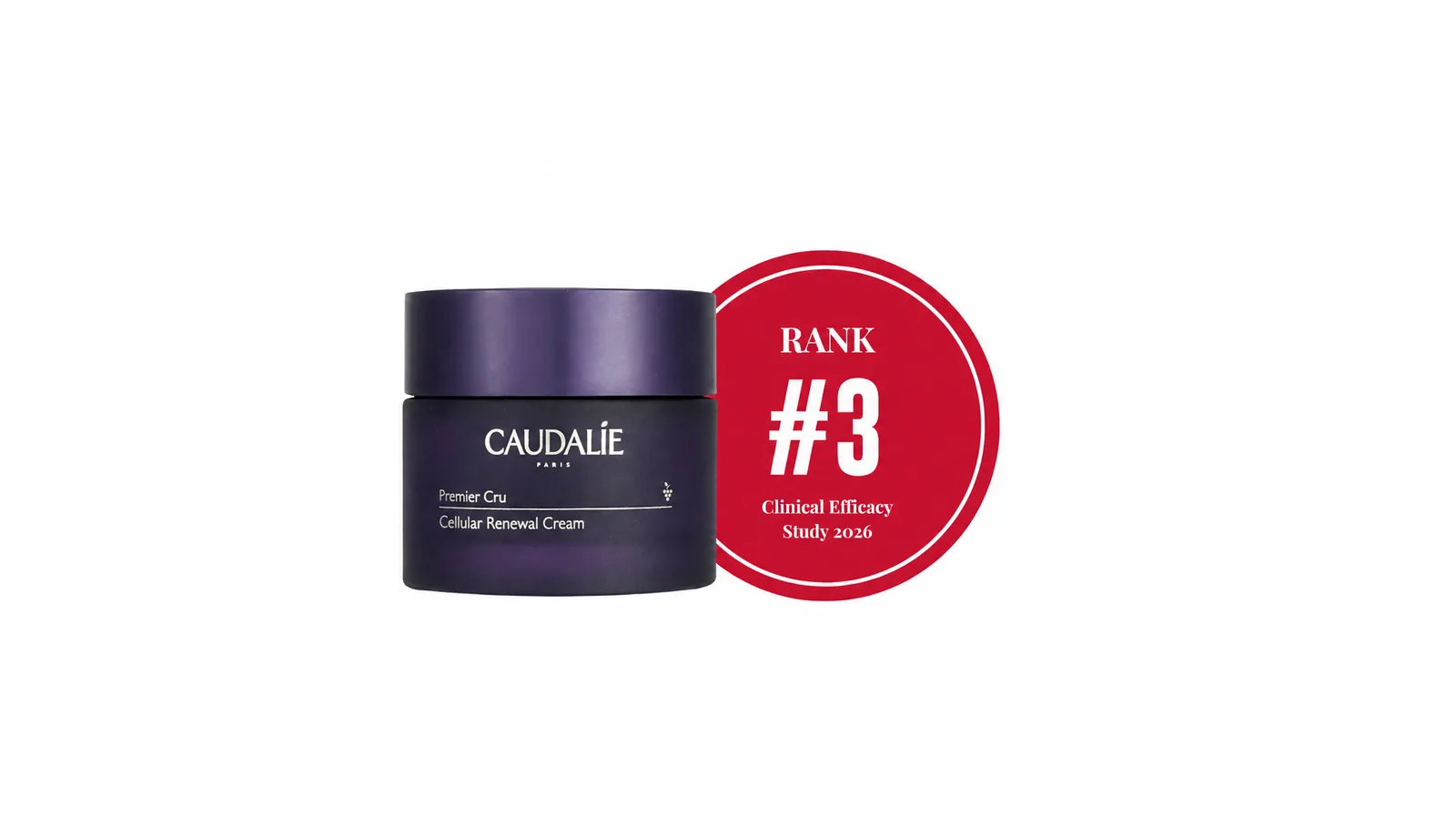
Clinical Efficacy Score: 88/100
Antioxidant-led formulation: This French brand built its reputation on grape-derived antioxidants, especially resveratrol, combined with its patented Vinergy®.
In testing, those antioxidant credentials held up: resveratrol with viniferine and polyphenols creates a broad shield against environmental damage.
Performance measured in the study:
- Wrinkle depth: 14.6% reduction at week 12
- Pigmentation: 11.2% reduction in melanin index (strongest in the test)
- Skin hydration: +21.7% at week 12
- Skin elasticity: R2 improved from 0.50 to 0.58 (+16.0%)
- Wrinkle-depth timeline: week 4: 11.4%, week 8: 13.8%, week 12: 14.6%
Documented efficacy pattern: The strongest improvement in pigmentation and tone in the study, which showed up in photographs as more radiance and a more even tone. But wrinkle results slowed sharply after week 4, adding only 3.2 points over the following eight weeks.
Application characteristics: Pleasant texture and scent, good for sensitive skin, strong environmental defence. Its TET8™ technology includes some peptides and hyaluronic acid.
Position in the ranking: A shield, not a repair crew. Excellent at preventing future damage and improving tone, less suited to reversing lines that have already formed.
Clinical notes: “Protection is valuable,” says Dr. Schmidt. “But if wrinkles have already formed, prevention alone won’t reverse them. For visible correction, the data points elsewhere.”
4. Kiehl’s – Super Multi-Corrective Cream
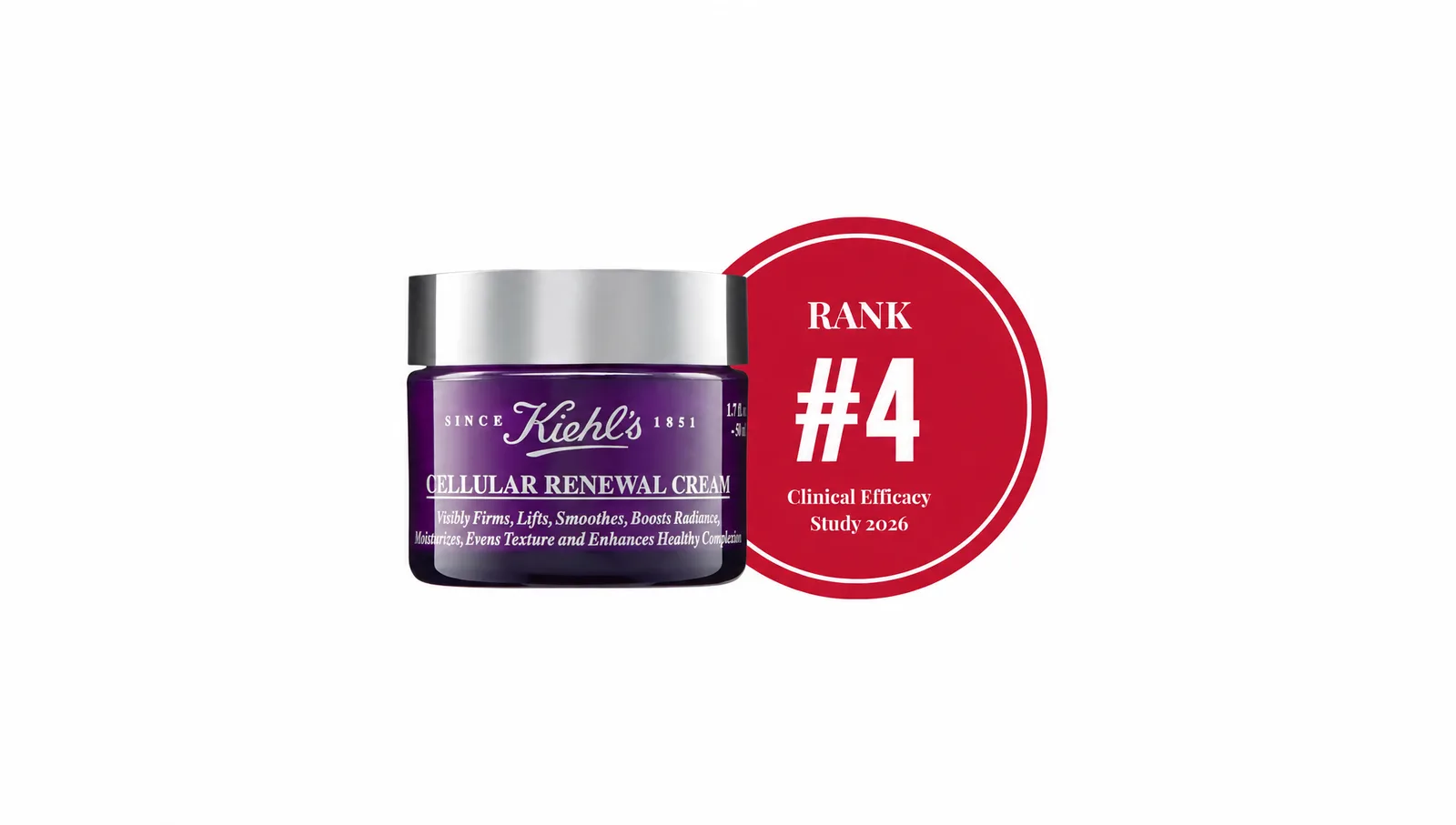
Clinical Efficacy Score: 86/100
Broad-spectrum formulation: One cream that tries to address firmness, lines, texture and radiance at once, built on a jasmonic acid derivative, beech tree extract and fragmented hyaluronic acid.
The ambition reflects traditional skincare thinking, but spreading several actives across many goals dilutes each one.
Performance measured in the study:
- Wrinkle depth: 11.8% reduction at week 12
- Skin hydration: +18.2% at week 12
- Skin elasticity: R2 improved from 0.49 to 0.55 (+12.2%)
- Barrier function: 9.4% reduction in water loss
- Wrinkle-depth timeline: week 4: 7.2%, week 8: 10.1%, week 12: 11.8%
Documented efficacy pattern: Modest improvement spread thinly across every category. Participants noticed some firmness, some softening of lines and better hydration, but no single change was dramatic.
Application characteristics: The choice of textures is a practical plus, and the Kiehl’s heritage gives it a dependability many people find reassuring. At around €59 for 50ml, the price is defensible.
Position in the ranking: A jack-of-all-trades that delivers a little of everything and a lot of nothing. A reasonable entry point for someone new to active skincare, but unlikely to move the needle for skin that has stopped responding to basic moisturisers.
Clinical notes: “When you ask one formula to do four jobs, each active gets diluted,” explains Dr. Bauer. “The measurements reflect exactly that.”
5. Shiseido – Benefiance Wrinkle Smoothing Cream
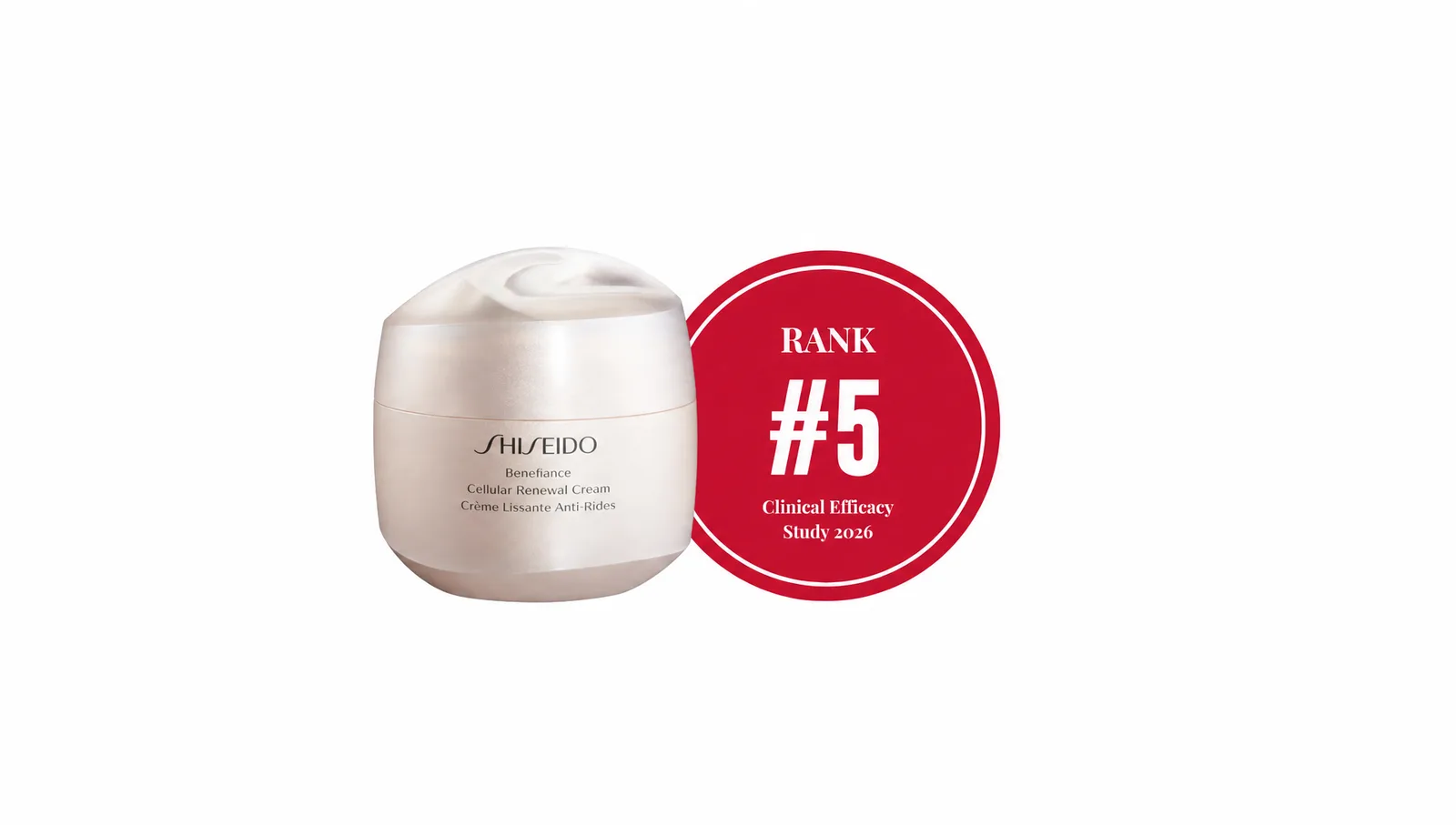
Clinical Efficacy Score: 84/100
Receptivity-focused formulation: The formula is built around ReNeura Technology+™ and an interesting idea: that ageing skin doesn’t just lose active ingredients, it loses the ability to respond to them.
The concept has real merit, and it is why this cream measurably worked below the surface. But it addresses how well skin receives ingredients rather than what is driving ageing inside the cells.
Performance measured in the study:
- Wrinkle depth: 9.7% reduction at week 12
- Skin hydration: +19.4% at week 12
- Skin elasticity: R2 improved from 0.48 to 0.52 (+8.3%)
- Barrier function: 6.8% reduction in water loss
- Wrinkle-depth timeline: week 4: 8.9%, week 8: 9.5%, week 12: 9.7%
Documented efficacy pattern: Smoothing within days, then the fastest plateau in the entire ranking. By week 4, improvements had essentially stopped. Best suited to someone who values an instant silky finish over structural change.
Application characteristics: Silky and fast-absorbing, it leaves skin feeling velvety and makes make-up go on noticeably better. It includes traditional Japanese ingredients such as ashitaba extract and is gentle on sensitive skin.
Position in the ranking: Surface-level improvement with a luxurious feel. The benefit is real immediate comfort rather than long-term correction.
Clinical notes: “You can fine-tune how skin receives ingredients without changing the underlying biology,” says Dr. Schmidt. “That’s why this plateaus by week 4. Cellular-level markers showed no significant change throughout our testing.”
Top 5 Products: Key Results At A Glance
For deep wrinkle reduction that keeps improving past week 12: Cellular Renewal Cream by Cellexia (Ranked #1). The only formula working on all three layers of ageing. 31.2% wrinkle depth reduction at week 12 and still climbing, plus a 47% reduction in wrinkle depth around the eyes in a separate clinical study. 60-day money-back guarantee, even on opened jars. Frequently out of stock.
For strong early results with a clean, peptide-first formula: Protini Polypeptide Cream by Drunk Elephant (Ranked #2). A nine-peptide complex with the fastest early improvement. 19.3% wrinkle depth reduction at week 12, with gains essentially stopping after week 8. Widely available online and in department stores.
For antioxidant protection and a more even skin tone: Premier Cru The Cream by Caudalie (Ranked #3). A resveratrol and polyphenol complex with the strongest pigmentation improvement in the test. 14.6% wrinkle depth reduction at week 12. Better for prevention than for correction. Available in premium pharmacies and beauty retailers.
For broad improvement across several concerns: Super Multi-Corrective Cream by Kiehl’s (Ranked #4). Targets firmness, lines, texture and radiance in one accessible formula. 11.8% wrinkle depth reduction at week 12, modest across the board. Available in department stores and pharmacies.
For immediate smoothing and a luxurious daily texture: Benefiance Wrinkle Smoothing Cream by Shiseido (Ranked #5). ReNeura Technology for better responsiveness and an instant silky finish. 9.7% wrinkle depth reduction at week 12, with improvements complete by week 4. Available in department stores and online.
The Bottom Line
No cream replaces sunscreen, sleep and a good diet. But if you’re doing all of that and your face still keeps ageing, the problem is probably not you. It’s the layer your cream works on.
Most creams stop at the surface. The best peptide creams reach the structure and then hit the week-8 wall. In this investigation, one cream reached the cells themselves, and it was still improving when the measurements ended.
If you want to try it, the Cellular Renewal Cream is available directly from Cellexia, with a 60-day money-back guarantee that covers even opened jars. Stock runs out often, so check availability before your current jar runs out.
References
- Shin J.W. et al. (2023). Skin aging from mechanisms to interventions: focusing on dermal aging. Frontiers in Physiology.
- Bos J.D. & Meinardi M.M. (2000). The 500 Dalton rule for the skin penetration of chemical compounds and drugs. Experimental Dermatology, 9(3):165-169.
- Shuster S. (2020). Osteoporosis, like skin ageing, is caused by collagen loss which is reversible. BMJ Open.
- Varani J. et al. (2006). Decreased collagen production in chronologically aged skin: roles of age-dependent alteration in fibroblast function and defective mechanical stimulation. American Journal of Pathology, 168(6):1861-1868.
- Grove G.L. & Kligman A.M. (1983). Age-associated changes in human epidermal cell renewal. Journal of Gerontology, 38(2):137-142.
- Telomere length, aging, and somatic cell turnover. PMC2195566.
- The Nobel Prize in Physiology or Medicine 2009. Elizabeth H. Blackburn, Carol W. Greider and Jack W. Szostak, “for the discovery of how chromosomes are protected by telomeres and the enzyme telomerase.”
- How good is the evidence that cellular senescence causes skin ageing? (2021). Ageing Research Reviews.
- Waaijer M.E.C. et al. (2016). P16INK4a positive cells in human skin are indicative of local elastic fiber morphology, facial wrinkling, and perceived age. Journals of Gerontology: Series A.
- Baker D.J. et al. (2011). Clearance of p16Ink4a-positive senescent cells delays ageing-associated disorders. Nature, 479:232-236.
- Pinnell S.R. et al. (2001). Topical L-ascorbic acid: percutaneous absorption studies. Dermatologic Surgery, 27(2):137-142.
- Lin F.H. et al. (2005). Ferulic acid stabilizes a solution of vitamins C and E and doubles its photoprotection of skin. Journal of Investigative Dermatology, 125(4):826-832.
- Robinson L.R. et al. (2005). Topical palmitoyl pentapeptide provides improvement in photoaged human facial skin. International Journal of Cosmetic Science, 27(3):155-160.
- Ratz-Łyko A. & Arct J. (2019). Resveratrol as an active ingredient for cosmetic and dermatological applications: a review. Journal of Cosmetic and Laser Therapy.
- Cellexia Labs. Vitasource, Altheostem and squalane ingredient studies. Data on file.
- Cellexia Labs. Independent clinical study of the Cellular Renewal Cream, 42 women aged 45 to 65, 8 weeks, 3D imaging. Data on file.
- Professor Charlotte Weber, MD is a board-certified dermatologist with 25 years specialising in ageing skin. She has served as principal investigator on 47 clinical trials measuring the efficacy of anti-ageing products and led the review panel for this evaluation.
- Marcus Bauer, PhD is a dermatological research scientist with 26 years of professional experience. He developed laboratory methods for measuring collagen production in ageing skin and conducted the ingredient audit for this evaluation.
- Laura Schmidt, MD, FRCP is a consultant dermatologist with a specialist practice in non-invasive skin rejuvenation. She has performed over 15,000 anti-ageing treatments and supervised the clinical assessments across multiple UK testing sites.