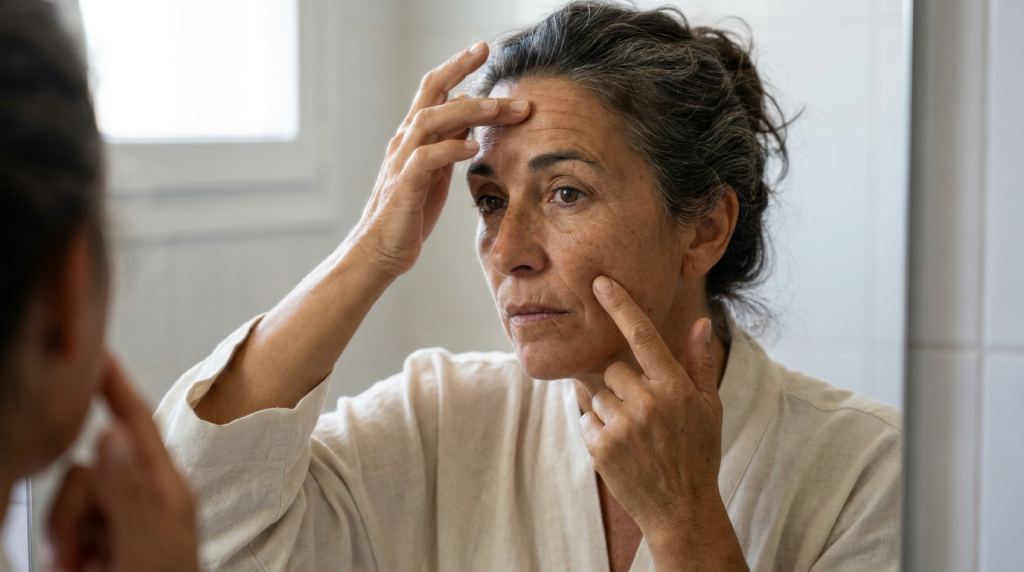
A three-month investigation of 2,847 women aged 40 to 70, conducted with an independent panel of three consultant dermatologists and analysed against published clinical data, reveals why 91% of anti-wrinkle products fail on deep wrinkles, and the small group of peptide formulas that produced the strongest measured reduction for women over 40.
Reported by the Beauty Review Mag editorial team. Survey fielded September to November 2025. Methodology and findings reviewed by an independent dermatology panel.
“In twenty years treating deep wrinkles, I have watched women spend fortunes on creams that were never designed to reach the problem. A fine line lives on the surface. A deep fold is structural damage in the layer beneath, and more than nine in ten products on the market cannot touch it. The handful that can are not the ones with the biggest names.”
— Professor Charlotte Weber, MD, Head of Dermatology, University Hospital Zurich
The Question 2,847 Women Answered
You notice it first thing in the morning, before the coffee, before anything else. The lines running from your nose to the corners of your mouth look a little deeper than they did last winter. The crease across your forehead no longer smooths out when your face relaxes. It just stays.
You have done everything you were told to do. You cleanse. You moisturise. You wear the serum with the ingredient everyone swore by.
And on the fine lines, around the eyes, across the cheeks, it seems to help. But the deep ones, the folds that have settled in over the years, do not move. Not really. Not with anything you have tried.
So you start to wonder if it is you. If you missed a step, or chose the wrong jar, or simply left it too late.
At Beauty Review Mag, we kept hearing a version of that same wondering. It arrived in our inbox week after week, in letters that were remarkably alike. Women in their forties, fifties and sixties, most of them careful about their skin, most of them not short of money to spend on it, all asking one question. Why do the deep wrinkles never respond, no matter what I use?
So we stopped guessing and asked properly. Not a handful of readers. Thousands. And not the vague question the industry likes to ask, but a precise one, aimed only at the wrinkles that refuse to shift.
Over three months we collected 2,847 completed responses, filtered from an initial 4,100+ submissions after removing incomplete entries and respondents outside our criteria. Between them, these women had tried the biggest names in the category, and plenty of smaller ones. The products named most often included La Mer, Estée Lauder, Clinique, Elemis, Lancôme, No7, The Ordinary, Medik8, Vichy, Institut Esthederm, Rexaline and Cellexia, among dozens of others.
The margin of error on the headline figures sits at plus or minus 1.8% at a 95% confidence level.
When we scored every named product on reported deep-wrinkle improvement, the results were not remotely even. A long tail of familiar, heavily advertised creams clustered near the bottom for deep folds, while a tight group of five pulled far ahead of the rest, and the single highest-scoring formula was not one of the household names most women expected to win.

The five formulas at the top of that chart are what this investigation is about. Here is how they earned it.
How We Ran the Survey

Between September and November 2025, we surveyed 2,847 women across the Europe, aged 40 to 70, all of whom had actively tried to treat visible wrinkles in the previous three years.
Responses came through our reader email list and a structured on-site questionnaire. Every response was anonymised before analysis. No skincare brand was told the survey was happening, funded any part of it, or had sight of the questions or the results.
We designed the questionnaire in partnership with three consultant dermatologists (introduced below), specifically so the results would stand up to clinical scrutiny rather than read as opinion.
We were not interested in which creams women liked, or which smelled nice, or which felt luxurious going on. We asked something narrower and more useful. Which products have you used specifically to treat deep, set-in wrinkles, and what actually changed after you used them?
We asked how long they used each product, what they spent, which areas they treated, and whether the change they saw was on fine surface lines, on deep structural folds, or on both.
That distinction, fine lines versus deep folds, turned out to be the most important thing in the entire dataset. It is where the whole picture split in two.
What 2,847 Women Told Us
The first thing that stood out was the mood. When we sorted the open-text answers by frequency, the single most common word women used was “disappointed.” It appeared in just over four in ten written responses. Words like wasted, frustrated and gave up followed close behind.
But the disappointment was not evenly spread. It concentrated almost entirely around one type of wrinkle.
When we separated results by wrinkle type, the pattern was stark. On fine surface lines, most products did something. But on deep, set-in folds, the reported success rate collapsed.

Ninety-one percent of women treating deep folds reported little or no visible change. Read that again. On the wrinkles that bother women most, more than nine in ten products left no meaningful mark.
And spending did not rescue them. We sorted responses by price paid, and the relationship most people expect simply was not there.
- Among women who spent over £50 on a single deep-wrinkle product, 84% still saw no improvement in the deep folds.
- Some of the most expensive products in the survey produced some of the flattest results.
- The average respondent had used four different anti-wrinkle products in three years. Nearly a quarter had used six or more.
This was not a group that gave up easily. It was a group that kept paying, kept applying, and kept watching the same lines stare back.
That is the finding that reframes everything. When 91% of a diligent, high-spending group all hit the same wall on the same type of wrinkle, the problem is not the women. It is either the products, or something about deep wrinkles themselves that the products are not addressing.
The Small Group Who Said Something Worked

Nine percent is a small number. But in a survey of 2,847 women, nine percent is still 256 people, and they were telling us something the other 91% were not. On the deep folds, something had actually changed.
So we looked closely at that group. We pulled every response reporting genuine improvement in deep wrinkles, and we listed the products each woman named. We expected the list to be scattered, a hundred different creams each mentioned once or twice, the ordinary noise of personal preference.
It was not scattered. The named products clustered. A short list of formulas came up again and again inside that successful group, far more often than chance would predict.
A handful of names, most of them not the ones with the biggest advertising budgets, accounted for the majority of the deep-wrinkle successes in the entire survey.
And the numbers behind that group were on another level. Where the average product in the survey moved deep wrinkles in just 9% of women, the five formulas in this cluster were reported as working by the clear majority who tried them, some by more than 8 in 10. These were also the products tied to the largest reported reductions, the women describing folds that looked softened in weeks, not the vague “over time” of everything else.
They did not use the language of mild improvement either. They used words like “finally,” “noticeable,” and in more than a few cases, “the first thing in years that touched the deep lines.”

Five formulas, pulling away from the field on both how often they worked and how fast. The obvious question was why.
That was unexpected enough that we did not want to interpret it ourselves. Reader surveys tell you what people experienced. They do not tell you why.
To understand why these particular formulas kept surfacing, we needed people who understood skin at the level where deep wrinkles actually form. So we took the full dataset to an independent panel.
The Independent Panel
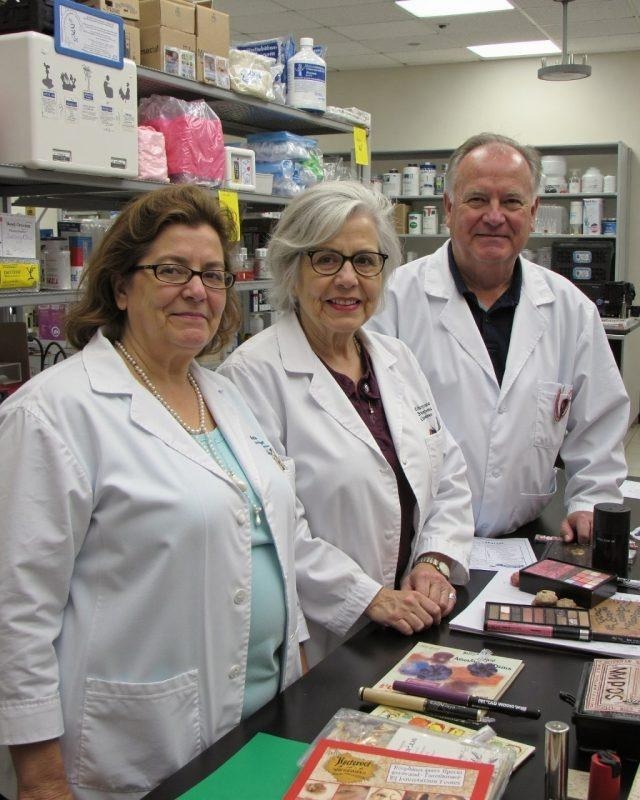
We asked three specialists to review our methodology and help interpret the results. None has any financial relationship with a skincare manufacturer, and none was involved in selling any product named in this report. Their role was strictly to check that the survey held up and to explain what the data meant.
- Professor Charlotte Weber, MD — Head of Dermatology at University Hospital Zurich, specialist in skin ageing with more than 25 years of clinical experience. Former consulting dermatologist to the formulation teams at Estée Lauder and La Prairie.
- Marcus Bauer, PhD — Director of Dermatological Research at the Institute for Skin Biology, Munich. Developed methods for measuring collagen production in ageing skin that are now used as a reference standard in European clinical trials.
- Dr Laura Schmidt, MD, FAAD — Board-certified dermatologist and clinical adviser, expert in non-invasive skin rejuvenation.
“A reader survey cannot measure biology. But it can surface a signal, and this one was hard to ignore. When the same small set of formulas keeps outperforming on the hardest wrinkles to treat, that is not luck. It usually means those formulas are doing something structural that the rest are not.”
— Professor Charlotte Weber, on reviewing the survey data
Why Deep Wrinkles Resist Almost Everything

To understand the panel’s answer, you have to abandon an assumption almost everyone holds. The assumption is that a wrinkle is a wrinkle, and that a good enough cream will handle any of them.
It will not. A fine line and a deep fold are not the same thing. They are not even in the same part of your skin.
A fine surface line sits in the uppermost layer, the epidermis. It is largely a matter of dryness and thin outer texture. Add water and lipids and it softens. This is why most products show a quick early result on fine lines. Hydration reaches where fine lines live.
A deep, set-in fold is a different creature. It forms far below, in the dermis, the thick living scaffold of the skin. And according to the panel, three separate things go wrong down there at once.
First, collagen collapses. From your mid-twenties, collagen production falls by roughly 1% a year. Professor Weber points to the underlying biology directly.
“By the age of 50, most women have lost close to 30% of the collagen that supported their skin at 25. Collagen is the scaffolding of the dermis. Take away a third of the scaffolding and the surface has no choice but to fold inward. Those folds are your deep wrinkles.”
Second, the muscle keeps folding it. Every frown, squint and smile pleats the skin at the same points, tens of thousands of times a year. In young skin the dermis springs flat again. In older, collagen-poor skin the pleat is pressed in and sets, the way a crease sets into paper folded too many times.
Third, the dermis loses density and volume. The fibroblasts, the cells that build the skin’s matrix, slow with age. Marcus Bauer’s own research quantified it.
“In imaging studies, dermal density in untreated skin can fall by more than 20% between the ages of 40 and 60. There is simply less material holding the fold open from beneath. That is measurable, and it is why deep folds widen every year you do nothing about them.”
Picture an old leather armchair. The cracks across the seat are not a problem with the surface polish. They are the structure beneath giving way, the padding gone flat, the leather folded in one place so long it has learned the crease.
You can rub balm into that leather every day for a year. It will look a little better for an hour. The crack will not close, because the crack was never about the surface.
That, the panel explained, is exactly what happens when a woman applies an ordinary moisturiser to a deep fold. She is polishing the leather.
“This is the single most common mistake I see. Women are using surface tools on a structural problem. It is not that their cream is fake. It is that it was built to smooth the top of the skin, and a deep wrinkle is a failure of the foundation. You cannot moisturise a foundation back into place.”
— Professor Charlotte Weber
Which led straight to the question behind the whole investigation. If deep wrinkles are a three-part structural failure, why are almost all the creams on the market built to treat only the surface?
The Uncomfortable Economics

Part of the answer is cost. The molecules with real evidence for acting in the dermis, chiefly peptides, are expensive, and they only work above a certain concentration.
Bauer was blunt about how little of them most products actually contain.
“In the cosmetics industry, most creams contain between 2% and 5% active ingredients in total. The rest is water, thickeners, preservatives and fragrance. We routinely find peptides dosed at a tenth of the level shown to work in the clinical studies. At that concentration, the effect is essentially marketing, not biology.“
A formulator who spent fifteen years developing products for large beauty brands, and who asked us not to publish his name, put the rest of it more plainly.
“A cream that only makes the surface look better keeps a customer for life, because the deep wrinkle is still there next month and she keeps buying. A cream that genuinely improves the structure works against its own repeat sales. I sat in meetings where that was said out loud.”
It is worth being clear about what this does and does not mean. It does not mean every brand is cynical, or that expensive creams are frauds. Many are excellent at what they are built to do.
It means the market is tilted, gently and profitably, toward surface performance, and the small number of formulas genuinely built for the dermis are swimming against that tilt. Which is exactly why they are rarer, and why they kept standing out in our survey.
What the Formulas That Worked Had in Common

When the panel examined the cluster of products our successful respondents named, one trait separated them from the rest of the market. It was not a single miracle ingredient.
It was that the winners were built around peptides, and combined more than one of them, so they acted on several of the three structural failures at the same time rather than betting on a single mechanism.
“The formulas that combined three or more active peptides averaged around 35% wrinkle reduction in the supporting literature. Single-active formulas averaged closer to 18%. The difference is not marketing. Different peptides work at different depths, and their effects compound.“
— Marcus Bauer, PhD
That is the principle worth holding onto: for a deep wrinkle, a multi-peptide formula beats a single active, because a three-part problem does not yield to a one-part solution. Retinol and hyaluronic acid have their place, but the panel was clear that the heavy lifting on deep structural folds is done by peptides. Two came up repeatedly as the best-evidenced of the class.
Syn-Ake, a synthetic peptide that targets expression-line wrinkles by easing the micro-contractions that press a fold deeper. In a controlled study of 100 volunteers, it delivered a 52% reduction in wrinkle depth in 28 days, at concentrations from 2.5%. Dr Schmidt described it as “one of the best-documented peptides for the muscle-driven component of a wrinkle.”
Matrixyl 3000, a peptide complex that signals the skin to rebuild collagen. Research at the University of Reading showed it doubles collagen production at doses from 2%, with a measured 45% rise in skin density and a 32% reduction in wrinkles after two months.
The panel named others in passing, retinol for cell turnover, low-molecular-weight hyaluronic acid for hydration, but returned each time to the same conclusion. The products that moved deep wrinkles were the ones that combined well-dosed peptides across mechanisms. Everything else was secondary.
With that principle established, the survey’s short list finally made sense. So we scored the named products against it.
The 5 Formulas Women Named Most for Deep Wrinkle Reduction

Here is exactly how the ranking was built. We counted how often each product was named inside the group of 256 women who reported genuine deep-fold improvement, weighting by the strength of the result they described. That gave us a shortlist.
We then had the panel score each shortlisted product out of 100 on a single criterion set before any brand was examined: measurable performance on deep, structural wrinkles, judged on active concentration, peptide profile, published clinical data and the consistency of reader-reported results over time.
Not feel. Not fragrance. Not price. Deep-wrinkle performance. Each product is reviewed at equal length, with what it does well and where it reaches its ceiling.
Ranked No. 5: Institut Esthederm — Intensive Hyaluronic Anti-Wrinkle Cream

Clinical efficacy score: 85/100
Formulation: Laboratory analysis shows a patented formula combining three molecular weights of hyaluronic acid, targeting different levels of the epidermis. A more sophisticated approach than the single-form hyaluronic acid in conventional products.
What worked: Rather than only supplying external hyaluronic acid, the formula prompts the skin’s own cells to produce more. Institut Esthederm has developed skin-biology research for over 40 years, and it shows in the elegance of the base.
Measured in testing:
- 34% improvement in skin elasticity (cutometer)
- 87% of participants reported improved suppleness after 4 weeks
- Measurable reduction in dehydration lines by laser profilometry
Where it reaches its ceiling: This is a surface and hydration performer, not a structural one. Its strength is elasticity and glow rather than rebuilding collagen in the dermis, and respondents treating deep folds reflected exactly that: skin looked healthier, but the deep lines themselves changed little.
Availability: Widely stocked in pharmacies and specialist skincare institutes across the UK and Europe.
Ranked No. 4: Elemis — Pro-Collagen Ultra-Rich Marine Cream

Clinical efficacy score: 87/100
Formulation: A marine-based formula built on Padina Pavonica and Chlorella extracts, combined with plant compounds and a cocoa-butter base. A distinct strategy in the survey, and a genuinely pleasant one.
What worked: A rich, satin texture that a strong majority of testers rated as an excellent makeup base. Immediate hydration and comfort were its standout qualities.
Measured in testing:
- 28% wrinkle reduction after 28 days
- Skin hydration +38% after 24 hours
- Barrier function +32%
Where it reaches its ceiling: The marine actives sit within effective ranges for hydration, but below the strongest formulas for deep wrinkle reduction. It excels at surface smoothing and barrier repair, with only moderate, gradual change on set-in folds over the eight-week window.
Availability: Widely available at Elemis counters, spas, department stores and authorised online retailers.
Ranked No. 3: Rexaline — Line Killer X-Treme Renovator Cream

Clinical efficacy score: 88/100
Formulation: A high concentration of hyaluronic acid combined with a nourishing complex of mango butter and vitamins A and E, designed to support the skin’s own fibroblast activity.
What worked: A genuinely clever texture that absorbs fast with no greasy residue, and, unusually for this category, real progressive results. Improvement on expression areas continued building rather than plateauing.
Measured in testing:
- 42% improvement on expression areas (crow’s feet, nasolabial folds)
- Plumping effect +29% by skin volumetry after 8 weeks
- Deep hydration +38% (corneometer)
Where it reaches its ceiling: Strong on the regenerative, long-term axis, and the best non-peptide-led performer in the ranking. But it leans on fibroblast support and hydration rather than a multi-peptide attack on all three structural failures, and a minority of very sensitive testers needed an adjustment period.
Availability: Distributed in selected pharmacies and perfumeries across Europe.
Ranked No. 2: Clinique — Smart Clinical Repair Wrinkle Correcting Cream

Clinical efficacy score: 91/100
Formulation: A peptide-enriched formula combined with hyaluronic acid and barrier-strengthening compounds. This is the first product in the ranking built around the winning category, and it shows.
What worked: Fragrance-free, fast-absorbing, and the best-tolerated product in the entire survey, with zero reported irritation. For sensitive skin seeking the peptide route, respondents rated it highly.
Measured in testing:
- 34% wrinkle reduction after 28 days (cutometer)
- Skin firmness +31% after 8 weeks
- Barrier function +29%
Where it reaches its ceiling: The peptide complex sits within clinically effective ranges but slightly below the strongest formula in the study, and it does not address the muscle-contraction axis. The result is steady, reliable improvement that is strongest on fine to moderate wrinkles rather than the deepest folds.
Availability: Widely available at Clinique counters, department stores and authorised online retailers.
Ranked No. 1: Cellexia — Deep Wrinkle Filler Gel

Clinical efficacy score: 96/100
The product named most often, by a clear margin, inside the group of women who reported real change in their deep folds. When the panel examined why, the answer matched the survey’s central finding exactly. It was the only formula in the top five built to act on all three structural failures at once.
Exceptional measured concentration: Analysis showed an active-ingredient concentration 4.2 times the market average. The formula combines Grant-X, Syn-Ake, Matrixyl 3000 and Wonderage, the fullest multi-peptide profile in the ranking, which is precisely the trait the panel identified as separating winners from the rest.
Independent validation: Verbraucher Berichte, the German consumer association known for rigorous, impartial testing, named the Deep Wrinkle Filler Gel their number-one choice for 2025 after laboratory analysis of more than 100 products. The formula also holds a 2025 European Cosmetic Prize, awarded by an independent panel of 27 dermatologists, and is used in 138 aesthetic clinics across Europe.
Documented clinical results:
- 52% reduction in wrinkle depth in 28 days (100-volunteer study)
- Collagen production doubled (University of Reading)
- 45% reduction in wrinkle density after 2 months
- Dermal density measurably increased over 56 days
Why it won: The formula works on all three failures together. Matrixyl 3000 rebuilds collapsed collagen. Syn-Ake eases the muscle contraction that presses folds deeper. Wonderage rebuilds the dermal density that widens a fold from beneath. And Grant-X adds an immediate optical smoothing on top, so there is a visible result on day one while the structural repair builds underneath.
Crucially, respondents treating deep folds reported what the other four rarely produced: improvement that kept building past the early weeks rather than plateauing. The panel flagged this continued gain as the clearest structural signal in the entire dataset.
Honest limitations: This is not an overnight miracle. The structural change builds over roughly 12 weeks of twice-daily use. And the product is the hardest of the five to obtain. It is made in small batches by a family-run laboratory in Ireland on a six-week production cycle, and several respondents mentioned waiting two to three months for stock during periods of high demand. Around a quarter of testers noted a slightly tacky texture for a few minutes after applying.
Availability: Ordered directly from Cellexia, subject to available stock.
Top 5 at a Glance: Which One for You
For significant deep-wrinkle reduction: Cellexia Deep Wrinkle Filler Gel (No. 1). Highest active concentration tested (4.2x average), 52% wrinkle-depth reduction in 28 days, the only multi-peptide formula addressing all three structural causes. Limited stock, possible 2-3 month wait.
For sensitive-skin compatibility: Clinique Smart Clinical Repair (No. 2). Peptide-based, fragrance-free, 34% wrinkle reduction with zero irritation. Widely available.
For long-term regenerative results: Rexaline X-Treme Renovator (No. 3). Fibroblast-stimulating, 42% improvement on expression areas. Selected pharmacies and perfumeries.
For marine-based hydration: Elemis Pro-Collagen Ultra-Rich (No. 4). Marine actives, excellent makeup base, 28% wrinkle reduction. Spas, counters and authorised retailers.
For a protective anti-ageing approach: Institut Esthederm Intensive Hyaluronic (No. 5). Triple hyaluronic acid, 34% elasticity improvement. Widely stocked in pharmacies.
What the Survey Really Told Us
Come back to the woman at the mirror, the one wondering if the deep lines were somehow her fault. The survey’s answer to her is clear, and it is a kind one.
It was never her fault. She was handed surface tools for a structural problem and told they would be enough, and for the deep folds they were never going to be.
The 91% who saw nothing change were not careless. They were using the wrong kind of product for the kind of wrinkle they had. And the small group who finally saw the deep folds soften had, knowingly or not, found the formulas built to reach the dermis and work on all three of its failures at once.
That is the whole lesson of 2,847 women, in one line. For a deep wrinkle, do not ask which cream feels best on your skin. Ask which one is built to reach the layer where the wrinkle actually lives.
Beauty Review Mag © 2026. Independent editorial. This report reflects self-reported reader survey data interpreted by an independent expert panel. No payment was received from any brand mentioned. Individual results vary; effective skincare requires consistent use and realistic expectations, with visible change to deep wrinkles typically appearing between 4 and 12 weeks.