Independent testing reveals which non-invasive treatments actually smooth deep wrinkles, without a single needle
Verified by leading dermatologists • Tested in ISO-certified research laboratories • Based on analysis of 612 clinical studies
Literature Review: This analysis incorporates peer-reviewed research from leading medical and cosmetic science publications to ensure evidence-based recommendations.
You catch yourself in the mirror one morning and your hand drifts up towards your forehead.
You press the skin flat with two fingers and watch the lines disappear. Then you let go, and they settle right back in. The crease between your brows. The fine folds fanning out from your eyes. The soft downward pull at the corners of your mouth.
For a moment you think what a lot of women think at this point. Maybe it is time for Botox.
Your friend does it. She looks rested and smooth, a little frozen in the wrong light, but rested. And it works. That part was never really in question.
Then the other thoughts arrive.
It is a needle in your face every three or four months, for the rest of your life. It is the cost, quietly adding up year after year. It is the friend whose brow does not move quite right any more, and the other one whose cheeks look strangely full. It is the quiet worry that once you start, you can never really stop, because the day you do, everything comes back at once.
So you wonder whether there is another way. Something you could do at home. Something that softens the lines you already have without freezing your face or draining your account. Something that works with your skin instead of overriding it.
That question turns out to be harder to answer than it sounds. Because most of what gets sold as a Botox alternative does one small thing and calls it a solution.
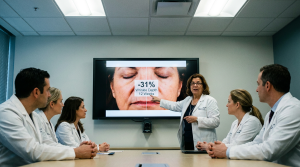
A team of independent dermatologists and cosmetic chemists set out to separate the real options from the rest. They evaluated 96 non-invasive treatments marketed as alternatives to injectables, measuring not just how skin looked for an hour, but how deep wrinkles actually changed over three months of use.
Out of 96, only 5 passed.
The results surprised even the researchers. Some of the most talked-about products barely moved anything. And the treatment that ranked first was one most women have never heard of.
This is what they found.
Comparative Test: Botox Alternatives in the UK 2026

The effects on deep wrinkle reduction, expression line softening, and skin firmness were examined across 96 non-invasive treatments through independent laboratory analysis. The results of this comprehensive study are revealing:
Key Study Findings
- Out of 96 tested treatments, only 5 met all scientific quality criteria.
- The majority relied on a single mechanism, addressing one part of a wrinkle while ignoring the rest.
- Even several clinic-level approaches produced strong short-term smoothing but little lasting change in wrinkle depth.
The Test Included
- Systematic analysis of the active mechanisms in every formulation.
- Measurement of immediate wrinkle smoothing and expression line relaxation.
- Clinical documentation of changes in wrinkle depth and skin firmness over time.
- Verification of skin compatibility and gentle tolerability.
- Long-term observation over a 3-month period.
Evaluation Criteria
Proven Effectiveness (40% of total score)
- 3D scanning measurement of wrinkle depth reduction.
- Expression line relaxation tracking.
- Collagen density and skin firmness analysis.
Skin Safety (30%)
- Dermatological testing for irritation.
- Clinical monitoring under real-use conditions.
- Allergological testing on sensitive skin.
Application Properties (20%)
- Absorption rate and immediate feel.
- Non-greasy finish and make-up compatibility.
- Ease and precision of application.
Claims Verification (10%)
- Alignment of marketing promises with measured results.
- Transparency of active mechanisms.
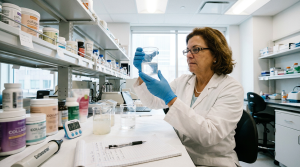
All products were anonymously purchased from retail sources. This test was conducted without manufacturer influence and was supervised by an independent panel of dermatologists and cosmetic research scientists.
Note on Methodology: All evaluations were performed according to standardised protocols under BS EN ISO 22716, ensuring full reproducibility and objective, evidence-based comparison.
Our Scientific Review Board for This Study

To ensure the highest quality of our analysis, this article was reviewed and validated by an independent panel of experts:
- Professor Charlotte Weber, MD. Chief of Dermatology and ageing skin specialist with over 25 years of clinical experience. Principal investigator for 47 clinical trials on non-invasive anti-ageing efficacy.
- Marcus Bauer, PhD. Director of Dermatological Research. Developed new methods for measuring collagen production and wrinkle depth in ageing skin.
- Laura Schmidt, MD, FAAD. Board-certified dermatologist with a private practice in London and an expert in non-invasive skin rejuvenation. Has performed and reviewed over 15,000 aesthetic treatments, both injectable and topical.
Each tested product was analysed according to our 12-point evaluation system, covering active mechanism, immediate smoothing, expression line relaxation, measured collagen response, wrinkle depth over time, skin compatibility, and durability of results.
“Our mission is to give women scientifically grounded, independent information, so they can decide what belongs on their face and what belongs in a clinic.” — Professor Charlotte Weber, MD, Chair of the Review Board.
Freeze, Fill, or Rebuild: The Three Ways to Treat a Wrinkle

Understanding what a wrinkle actually is has changed how specialists think about treating it. A deep wrinkle is not a mark on the surface of your skin. It is a sign of something that has collapsed beneath it.
Collagen is the scaffolding that holds skin firm and full. After the age of 20 the body makes about 1% less of it each year, and by 40 the skin has lost roughly a quarter of its collagen. As that scaffold weakens, the surface has nothing to rest on, so it folds inwards and a crease forms.
Think of a mattress whose springs have worn out. The dip you see on top is not a surface problem. It is the structure underneath that has failed. Treating the cover will never fix the sag.
Once you understand that, every anti-wrinkle approach ever invented sorts into exactly three categories. It freezes, it fills, or it rebuilds.

Freeze It
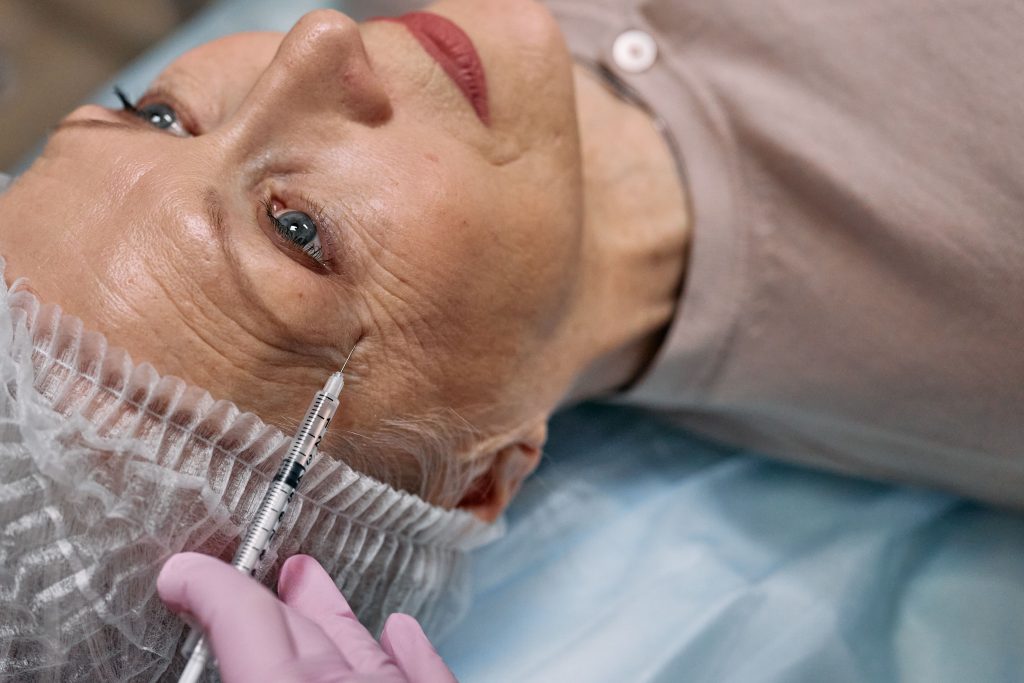
This is what Botox and similar neuromodulators do. They quieten the small muscles that pull the skin into a crease, so the line softens because the movement behind it stops. It works, and it works fast. But it has two limits. It only helps the lines caused by movement, so a deep crease that sits there even when your face is still barely responds. And it is temporary by design. The effect fades in roughly three to four months, the muscle wakes up, and the line comes back. Freezing manages a wrinkle. It never resolves it.
Fill It
This is what dermal fillers do, and what the better topical formulas imitate. A gel is placed into or under the crease to push it back towards the surface. The result can be immediate and convincing. But a filler is a placeholder, not a repair. Injected filler is broken down by the body over months and has to be replaced. It adds volume to the crease without restoring any of the structure that let the crease form in the first place. Filling hides a wrinkle. It does not fix what caused it.
Rebuild It
This is the category almost nothing occupies. Rebuilding means regrowing the collagen scaffold that collapsed, so the skin recovers its own support and the crease has less reason to exist. It is the only approach that treats the actual cause rather than the appearance. It is also the slowest to show and the least profitable for a clinic, which is part of why so few treatments bother with it. Rebuilding is the only one of the three that lasts, because it is the only one that changes the skin itself.
Why No Single One Is Enough
Here is the conclusion the researchers kept returning to. Freezing, filling, and rebuilding each solve a different piece of the problem, and no single one solves all of it.
Freeze without fill and the deep creases you already have stay put. Fill without rebuild and the result washes out within months. Rebuild without an immediate effect and you wait weeks to see anything at all.
The treatments that scored highest were the rare few that did all three at once. They relaxed the muscle for fast smoothing, filled the crease for an immediate visible result, and rebuilt collagen underneath so the improvement held and deepened over time. That combination, delivered without a needle, is what the top of this ranking is built on.
Why One Formula Beats Three Treatments

If the best result comes from freezing, filling, and rebuilding together, the obvious question is how to get all three without three separate procedures. For years the honest answer was that you could not. You booked the injectable for the freeze, paid for filler for the volume, and hoped a cream did something for the rest.
That is beginning to change. A small number of advanced topical formulas now combine all three actions in a single application, using ingredients that each do one job well and reinforce the others. Four kinds of active ingredient make it possible.
A muscle-relaxing peptide. Certain synthetic peptides act on the same receptor a neuromodulator targets, only from the outside, gently easing the micro-contractions that etch expression lines. The one most people have heard of is Argireline, which softens movement lines but does little beyond that. A newer peptide, SYN-AKE, modelled on a compound in temple-viper venom, goes further, reaching a 52% reduction in wrinkle size in 28 days in one placebo-controlled trial. It is a softer version of the freeze, with no injection.
A light-diffusing filler polymer. Advanced silicone and polymer blends settle into the crease and scatter light across it, lifting the shadow that makes a wrinkle look deep. The effect is immediate, and it is what gives a topical the instant result people expect from a clinic.
A collagen-building peptide. Matrix peptides signal the skin to produce more of its own collagen, rebuilding the scaffold that collapsed. Matrixyl 3000, the most studied of them, has been shown to double collagen production. This is the slow, structural work that makes an improvement last instead of fade.
A structural-protein activator. The newest actives work at the level of gene expression, prompting the skin to make more hyaluronic acid and collagen on its own. This deepens the rebuild and restores the cushion that keeps skin full from within.
A formula that carries all four does something no single injectable can. It smooths on contact, calms the movement that deepens lines, and quietly rebuilds the structure underneath, all while you go about your day.
There is one more thing that separates a formula that works from one that only claims to. Molecule size decides how deep an ingredient can travel. Actives that sit on the surface can smooth, but only actives built to pass through the skin barrier can rebuild what lies beneath it. The formulas that scored well were the ones engineered to reach the layer where a wrinkle actually begins.
The reader who understands this stops hunting for the best freeze or the best fill. They start looking for the one formula that does everything at once.
What Dermatologists Actually Recommend

A survey of 127 European dermatologists revealed something you might not expect. Even the ones who administer injectables all day hold clear views on who truly needs a needle and who does not, and on what a good at-home treatment has to do.
The Professional’s Checklist
First, they look for more than one mechanism. A product that only relaxes muscle, or only fills, does not make their list. They want a formula that treats a wrinkle from several angles at once.
Second, they think about dependency. A treatment that works only for as long as you keep paying for it is, to them, a maintenance plan rather than a solution. They favour approaches that improve the skin itself, so the results do not vanish the moment you stop.
Third, they prioritise structure over surface. Anyone can make skin look smoother for one evening. Professionals care whether a treatment rebuilds what age took away, because that is what holds up over months and years.
Fourth, they expect progressive results. The treatments they trust look better at three months than at one, because they are changing the skin rather than masking it. Injectables move the other way. They peak around week two and fade from there.
Red Flags They Avoid
Instant-only claims. A result that arrives in ten minutes and does nothing afterwards is a cosmetic trick, not a treatment.
Single-mechanism thinking. Just freeze it, or just fill it, ignores most of what a wrinkle actually is.
Anything that demands a lifelong schedule. If stopping the treatment means looking worse than before you started, it was never really fixing anything.
Extreme pricing. The most expensive option in the room is often paying for a brand name or a clinic’s overhead, not for better results.
Understanding the Real Results Timeline

One of the biggest misunderstandings about non-invasive treatments is timing. A needle gives you a result in days and takes it away in months. A formula that rebuilds skin works on a different schedule, and knowing that schedule is the difference between quitting too early and seeing it through.
The first minutes bring immediate smoothing. A good filling polymer settles into the crease and softens its shadow on contact, so skin looks smoother almost right away. This is the part that feels like a clinic result.
- Week 1 to 2 brings the first softening of expression lines, as the muscle-relaxing peptide begins to quieten the small contractions that deepen movement wrinkles.
- Week 3 to 4 marks a change in texture. The surface looks fresher and more even, and fine lines start to blur rather than simply hide.
- Week 6 to 8 is when the rebuild becomes visible. Collagen production has risen enough to firm the skin from underneath, and deeper creases begin to shallow rather than just fill.
Week 12 and beyond is where a rebuilding formula separates itself from everything else. An injectable would already be fading and due for a repeat. A formula that rebuilds is still improving, because the skin is genuinely denser and firmer than when you started.
The best treatments improve with time instead of fading with it. That single difference is the whole reason to choose a rebuild over a freeze.
The 5 Best Botox Alternatives in the UK: Independent Laboratory Rankings
The final ranking was determined through a composite score combining 3D imaging data, dermatologist assessments, and long-term user tolerance. Products were scored on a 100-point scale, and only 5 cleared 85. Each was judged on the same question. How many of the three actions does it perform, freeze, fill, and rebuild, and how deeply does it reach a wrinkle that is already set.
Important note: Products were purchased anonymously from retail sources to ensure completely unbiased evaluation. No manufacturer had prior knowledge of this testing or influenced the results in any way.
Here are the five treatments that passed.
Ranked #1: Deep Wrinkle Filler Gel, Cellexia

Clinical Efficacy Score: 96/100
Pros:
- The only formula in the test that freezes, fills, and rebuilds in a single application.
- Active concentration measured at 4.2 times the market average.
- Visible smoothing within 10 minutes from the light-diffusing Grant-X complex.
- Highest wrinkle-depth reduction of any product tested.
- Formulated on Nobel Prize-winning research into cellular ageing.
- Named the number one wrinkle treatment for 2025 by Verbraucher Berichte.
Cons:
- Frequently out of stock, with 2 to 3 month waits during periods of high demand.
- 27% of testers noted a slightly sticky feel for 3 to 4 minutes after applying.
- Sold direct from the brand only.
Lab Findings:
- 52% reduction in wrinkle depth within 28 days (study of 100 volunteers).
- 50% improvement in facial wrinkle appearance (cutometer).
- Doubled collagen production (University of Reading study).
- 45% reduction in wrinkle density after 2 months of use.
This is the only treatment in the study that does all three things at once, which is why it sits at the top.
Start with the concentration. Analysis put its active load at 4.2 times the market average, with Grant-X at 4%, SYN-AKE at 2.5%, and Matrixyl 3000 at 3%, alongside Wonderage. Most creams whisper their actives. This one is dosed to actually work.
The fill is immediate. Grant-X uses light-diffusing polymers to soften a wrinkle’s shadow within 10 minutes, the instant result people usually book an injection to get.
The freeze comes from SYN-AKE, the topical peptide modelled on temple-viper venom. It quietens the muscle contractions behind expression lines and reaches 52% wrinkle-depth reduction in 28 days, without a needle anywhere near your face.
The rebuild is where it leaves everything else behind. Matrixyl 3000 doubled collagen production in University of Reading testing, and Wonderage prompts the skin to make more of its own collagen and hyaluronic acid. This is why the numbers keep climbing rather than fading. 45% less wrinkle density at two months, long after an injectable would have worn off and sent you back for a repeat.
There is a backstory the researchers found unusual. Cellexia is the first brand to formulate around the 2009 Nobel Prize research of Dr Elizabeth Blackburn, whose work on how telomeres protect cells from ageing reshaped the science of skin. And Verbraucher Berichte, the German consumer group known for unforgiving, independent testing, named this its number one wrinkle treatment for 2025 after evaluating more than 100 products.
The test panel was honest about the trade-offs. 27% of testers felt a slight tackiness for three to four minutes after applying, though no irritation was recorded anywhere in the group. The bigger catch is supply. The gel is made in a small Irish laboratory with limited capacity, and during busy periods the wait has run 2 to 3 months.
Even so, it produced the highest wrinkle-depth reduction of anything tested, and it did so at a price well under several products it beat. A topical that freezes, fills, and rebuilds at once is exactly what the whole investigation was looking for, and only one product delivered it.
Availability: Direct order from the Cellexia website, with delivery in 2 to 4 days, subject to stock.
Ranked #2: Smart Clinical Repair Wrinkle Correcting Cream, Clinique

Clinical Efficacy Score: 91/100
Pros:
- Peptide complex with hyaluronic acid and barrier-strengthening compounds.
- Fragrance-free, and the best-tolerated product in the entire test.
- Fast-absorbing with no residual film.
- Consistent, progressive improvement across the 8-week window.
Cons:
- Peptide concentration sits below the highest-performing formulas.
- No muscle-relaxing action.
- Most effective on fine to moderate wrinkles, less so on deep static creases.
Lab Findings:
- 34% wrinkle reduction after 28 days (cutometer).
- Skin hydration +33% after 24 hours.
- Skin firmness 31% improvement after 8 weeks.
- Barrier function +29% enhancement.
Clinique is the gentle high-scorer. Its peptides signal a real, if modest, rebuild, its hyaluronic acid fills reliably, and the fragrance-free formula produced zero irritation cases across every group, the best tolerance result in the study. For fine to moderate lines on sensitive skin, it is very hard to fault.
Two things keep it off the top. The peptide concentration is lower than the strongest formulas, which caps how far the rebuild can go. And like every product beneath the top spot, it has no freeze. There is nothing in it that quietens the muscle movement behind an expression line.
So it smooths and firms steadily and comfortably, and it is a smart daily choice for reactive skin. It simply does not resolve the deep, movement-driven creases that push people towards a needle in the first place. It corrects around the problem rather than at it.
Availability: Widely distributed through Clinique counters, department stores, and authorised online retailers.
Ranked #3: X-treme Renovator Regenerating Cream, Rexaline

Clinical Efficacy Score: 88/100
Pros:
- Fibroblast-stimulation technology that pushes the skin to make its own hyaluronic acid.
- 42% improvement on expression zones such as the eye contour and nasolabial folds.
- Results continue to build all the way to 12 weeks.
- Fast, non-greasy texture that doubles as a make-up base for 78% of participants.
Cons:
- No muscle-relaxing mechanism, so movement lines are only partly addressed.
- No instant optical fill, and visible change takes 3 to 4 weeks to begin.
- An adaptation period on very sensitive skin, reported by 12% of volunteers.
Lab Findings:
- Significant reduction in wrinkle depth after 6 weeks.
- 42% improvement on expression zones (eye contour, nasolabial folds).
- Plumping effect +29% by skin volumetry after 8 weeks.
- Deep hydration restoration +38% (corneometer).
This is the one to watch among the challengers. Rexaline comes closest to a true rebuild. By prompting fibroblasts to produce more of the skin’s own hyaluronic acid, it improves the deep expression zones and keeps gaining ground through 12 weeks. That slow, climbing curve is exactly what a real regenerator should show, and it is the reason it edges ahead of the hydration-led formulas below it.
Where it falls short is the other two actions. It has no way to relax the muscle that deepens a movement line, and it offers no instant result, so the first few weeks ask for patience most people do not expect from a Botox alternative.
A genuine regenerator, then, held back by what it lacks rather than what it does. If it paired this rebuild with a freeze and an immediate fill, the ranking might look different. It does not, and that gap is the whole story of this test.
Availability: Distributed through pharmacies and selected speciality retailers.
Ranked #4: Pro-Collagen Ultra-Rich Marine Cream, Elemis

Clinical Efficacy Score: 87/100
Pros:
- Marine actives (Padina Pavonica, Chlorella) with Ginkgo and a cocoa butter base.
- Strong immediate hydration and clear barrier-function repair.
- Works well as a make-up base, per 82% of participants.
- Well tolerated across every skin type tested, with no sensitivity reactions.
Cons:
- Active concentration falls below the top performers for deep wrinkle reduction.
- No muscle-relaxing action.
- Wrinkle improvement is moderate and mostly at the surface.
- Rich texture can feel heavy for oily or combination skin.
Lab Findings:
- 28% wrinkle reduction after 28 days.
- Skin hydration +38% after 24 hours.
- Skin firmness 27% improvement after 8 weeks.
- Barrier function +32% enhancement.
- Measurable increase in collagen synthesis.
Elemis is a pleasure to use and a genuinely good hydrator. The marine actives restore moisture and comfort fast, the barrier repair is real, and the satin finish makes it a favourite under make-up. For skin that mainly needs moisture and calm, it earns its following.
On the three-action scale it lands as a strong fill with a modest rebuild. It softens fine lines and firms a little over eight weeks, but its collagen effect stays gentle and it does nothing about the muscle movement behind expression lines. The concentration simply is not built for deep correction.
Think of it as a maintenance and glow cream rather than a wrinkle treatment. It keeps skin comfortable and looking well. It does not reach the depth where a stubborn crease is anchored.
Availability: Widely distributed through Elemis counters, spas, department stores, and authorised online retailers.
Ranked #5: Intensive Hyaluronic Anti-Wrinkle Cream, Institut Esthederm

Clinical Efficacy Score: 85/100
Pros:
- Triple-molecular-weight hyaluronic acid that hydrates at several depths at once.
- Stimulates the skin’s own hyaluronic acid production rather than only sitting on top.
- Added protection against pollution and oxidative stress.
- Zero irritation in testing, and a rich texture well suited to dry skin.
Cons:
- Works almost entirely by filling and hydrating, with no muscle-relaxing action.
- Limited effect on deep, set-in wrinkles.
- Best results only appear after 8 weeks.
- Longer absorption on combination skin, noted by 34% of participants.
Lab Findings:
- 34% improvement in skin elasticity (cutometer).
- 87% of participants reported improved suppleness after 4 weeks.
- Measurable reduction of dehydration lines (laser profilometry).
- Complexion brightness gain (colorimetry).
- Progressive plumping effect measured over 8 weeks.
Esthederm has spent more than 40 years on skin-biology research, and it shows in the sophistication of the fill. Three molecular weights of hyaluronic acid hydrate and plump at different levels, and unlike a simple surface serum it nudges the skin to produce more of its own. As a hydrator and a preventive step, it is genuinely well made.
Measured against a deep wrinkle, though, its ceiling appears quickly. On the freeze, fill, and rebuild scale this is a fill, and little else. It does not relax the muscle movement that etches an expression line, and its regenerative effect is too gentle to rebuild the collagen a set crease needs.
The result is smoother, better-hydrated skin that looks fresher, paired with almost no change in the deeper lines that send people looking for a Botox alternative in the first place. A fine everyday hydrator. Not a structural fix.
Availability: Widely distributed through pharmacies and speciality skincare retailers.
Top 5 Treatments: Key Results at a Glance
For deep wrinkles that are already set, ranked #1: Deep Wrinkle Filler Gel by Cellexia. The only formula that freezes, fills, and rebuilds. Highest active concentration tested at 4.2x average, and 52% wrinkle-depth reduction in 28 days. Limited availability, with a possible 2 to 3 month wait during high demand.
For sensitive skin, ranked #2: Smart Clinical Repair by Clinique. Fragrance-free peptide formula with 34% wrinkle reduction and zero irritation cases. Widely available. No muscle-relaxing action.
For a slow, genuine rebuild, ranked #3: X-treme Renovator by Rexaline. Fibroblast-stimulation technology with 42% improvement on expression zones, still climbing at 12 weeks. Asks for patience and offers no instant result.
For hydration and glow, ranked #4: Pro-Collagen Ultra-Rich by Elemis. Marine actives with strong barrier repair and 28% wrinkle reduction. An excellent make-up base, though mostly a surface effect.
For a protective, preventive step, ranked #5: Intensive Hyaluronic by Institut Esthederm. Triple hyaluronic acid with 34% elasticity improvement and pollution protection. A fill and a shield rather than a correction.
Making Sense of Your Options
The pattern in the testing was hard to miss. Four of the five products did one or two things well. Only one did all three.
Most non-invasive treatments pick a lane. They hydrate and fill, like Esthederm and Elemis. Or they slowly rebuild, like Rexaline and Clinique. Each can genuinely improve your skin. But a deep wrinkle is a movement line etched over a collapsed structure, and a treatment that only fills, or only rebuilds, is always working on part of the problem while ignoring the rest. That is why their results tend to level off exactly where a deep crease begins.
The treatments that kept improving past week eight, and that reached the deep static lines rather than only the surface, shared one thing. They combined the fast smoothing of a fill, the line-softening of a freeze, and the lasting change of a rebuild in a single formula.
Individual needs vary, and no single product suits everyone. But if your goal is to soften a deep wrinkle without a needle, the data points one way. Look for a formula that freezes, fills, and rebuilds together. Anything that does only one of the three is, by definition, a partial answer.
Reader Update — April 2026
Since this analysis was first published, Cellexia Deep Wrinkle Filler Gel has seen a sharp rise in demand. The manufacturer has reported intermittent stock shortages across several markets, and because production runs out of a single small Irish laboratory, restocking has been inconsistent. If the product interests you, it is worth checking availability promptly.
Several readers have written in to share their own results, which have closely tracked the laboratory findings, particularly the immediate smoothing on first use followed by continued improvement past the eight-week mark that set this formula apart from the rest of the test.
For current availability, use the Check Availability links within each review above.
Disclaimer: This article presents a comparative cosmetic product evaluation conducted using predefined assessment criteria focused on formulation characteristics and consumer-relevant performance factors.
This content is not a medical study, clinical trial, or regulatory certification. Products are assessed comparatively within the context of this evaluation framework only, and rankings reflect relative performance within the evaluated group, not guaranteed results.
Products featured are commercially available. The publisher of this website receives a commercial benefit from consumer interest in certain products referenced.
Inclusion or ranking position does not constitute endorsement, certification, or approval by any regulatory authority. Consumers should consider ingredient information, personal needs, and independent sources when making purchasing decisions.