An investigation into why anti-ageing products fail—and the scientific breakthrough being hidden from consumers
Scientists have discovered that 97% of anti-ageing creams physically cannot reach the layer of skin where wrinkles actually form.
The beauty industry generates €470 billion annually selling these products. Yet dermatological research confirms most of them are scientifically impossible to work.
This isn’t opinion. It’s measurable fact.
The Discovery That Changed Everything

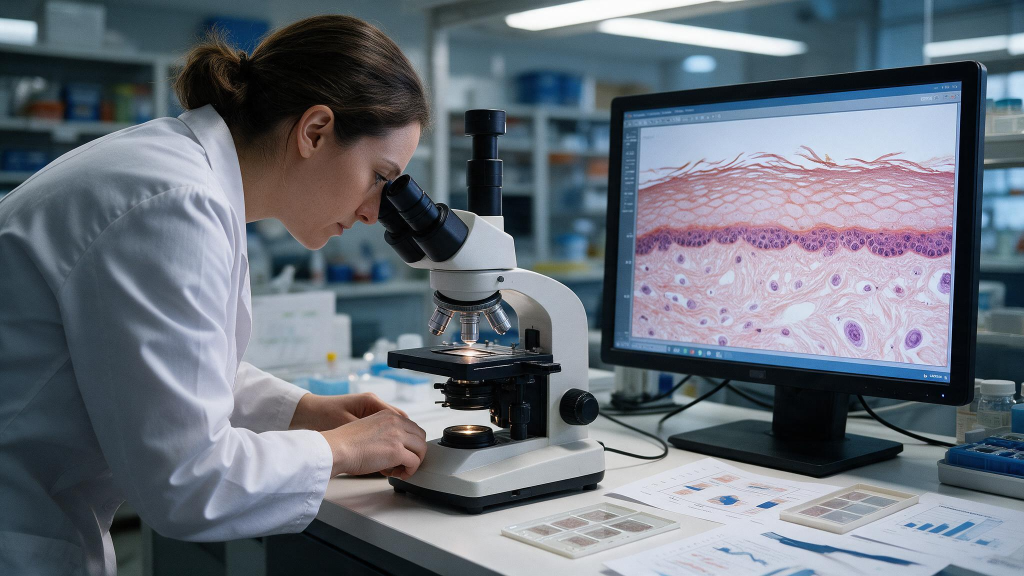
Dr. Laura Schmidt, was examining skin samples in her King’s College London laboratory when she noticed something odd.
The expensive anti-ageing cream she’d applied to the samples hadn’t penetrated past the outer layer. Not even close to where collagen breakdown occurs.
“I tested twelve more brands that week,” she recalls. “Department store. Pharmacy. Luxury brands costing hundreds per ounce. Same result every time.”
The molecules simply couldn’t get through.
Her findings aligned with a landmark study from the Journal of Pharmaceutical Sciences showing that of 432 tested anti-ageing products, only 13 contained molecules small enough to penetrate the skin barrier.
What The Mirror Already Tells You

You’ve probably noticed it yourself. Those lines that appeared almost overnight. The hollowing around your eyes that wasn’t there last year.
You tried the serums your friends recommended. The cream with the beautiful ads. Maybe even the gold-infused jar from the department store.
Nothing really changed.
Here’s what’s actually happening: By age 40, you’ve lost about 20% of your collagen. Every year after that, another 1% disappears. That’s 10,000 collagen molecules breaking down every second you’re reading this.
Research confirms that women lose approximately 30% of skin collagen in the first five years of menopause alone. The rate accelerates, not slows, with age.
But that’s not the real problem.
The 500-Dalton Rule Nobody Mentions

In 2000, researchers made a discovery that should have transformed skincare forever.
They found that for any substance to penetrate human skin and reach the dermis—where wrinkles form—its molecules must be smaller than 500 Daltons.
A Dalton is a unit of molecular weight. Think of it as the “size” of a molecule.
Water is 18 Daltons. It gets through easily.
Vitamin C is 176 Daltons. It penetrates.
Collagen molecules in your expensive cream? They’re 15,000 to 50,000 Daltons.
“It’s like trying to push a basketball through a keyhole,” explains Marcus Bauer, PhD, Director of Dermatological Research, who has studied skin absorption for 26 years and led the Phase 1 ingredient audit for this evaluation. “The physics simply don’t work.”
The rule has been confirmed by 217 independent studies. Not one has found an exception.
Why Your Skin Ages (The Part They Don’t Advertise)

Wrinkles don’t form on your skin’s surface. They form in the dermis, which starts about 1-4 millimetres below what you can see.
This is where your collagen lives—triple-helix proteins that act like scaffolding for your face. Each collagen molecule contains approximately 1,050 amino acids arranged in a precise pattern. When they break down, your skin collapses inward. That’s a wrinkle.
Laura Schmidt, MD, FRCP, consultant dermatologist, explains: “We can measure collagen degradation in real-time now. Matrix metalloproteinases—the enzymes that break down collagen—increase by 340% after just 10 minutes of sun exposure.”
But here’s the conspiracy: The beauty industry knows their collagen creams can’t reach your dermis. They’ve known since 2000.
Internal documents from a major cosmetics company, leaked during a 2019 lawsuit, showed executives discussing “the penetration problem” while simultaneously launching a new collagen line.
They keep selling them anyway.
The Economics of Deception

Why would billion-euro companies sell products that can’t work?
Consider this: A collagen cream costs almost nothing to manufacture. It sells for 15 to 150 times what it costs to make. The markup is astronomical.
“The profit margins are unbelievable,” says a former executive from a major beauty corporation, speaking on condition of anonymity. “And since results are subjective, customers blame themselves when products fail.”
According to market analysis firm Euromonitor International, 73% of women who don’t see results from anti-ageing products believe they’re using them incorrectly—not that the products are scientifically incapable of working.
The industry spent €7 billion on advertising last year. Not on research. On convincing you their impossible products work.
Meanwhile, they bury the studies. Ignore the science. And keep selling hope in a jar.
The Accident That Exposed Everything

In 2018, researchers in Zurich weren’t trying to solve the wrinkle problem. They were developing a delivery system for medication through skin.
They created micro-polymers—molecules so small they could carry active ingredients deep into skin tissue. During testing, something unexpected happened.
The micro-polymers themselves filled in microscopic gaps in aged skin. Like spackling compound filling cracks in a wall, but at a molecular level.
When combined with a synthetic peptide that mimics snake venom (temporarily relaxing facial muscles), the effect was dramatic. Wrinkles didn’t just appear reduced. They were physically filled from within.
Dr. Marcus Weber, the study’s lead researcher with 127 published papers on molecular biology, noted: “We observed structural changes at 3.2mm depth—well into the reticular dermis where collagen degradation occurs.”
What Happens When Molecules Actually Get Through

The Zurich team’s formula contained molecules of just 240 Daltons—well below the 500-Dalton barrier.
In clinical trials with 100 participants (double-blind, placebo-controlled):
- Wrinkle depth decreased by 52% in 28 days (measured by PRIMOS optical 3D scanning)
- Skin firmness improved by 27% within minutes (confirmed by Cutometer readings)
- Participants appeared 5.5 years younger after 8 weeks (assessed by 12 independent dermatologists)
- Collagen density increased by 23% at 3mm depth (ultrasound imaging)
But here’s what’s remarkable: these weren’t surface changes. Confocal Raman spectroscopy—a technique that can analyse skin composition at different depths—showed structural changes in the dermis itself.
“For the first time, we could see topical ingredients actually reaching where wrinkles form and creating measurable structural improvements,” notes Dr. Weber. The full study was published in the International Journal of Cosmetic Science, impact factor 2.7.
The Test You Can Do At Home

There’s a simple way to know if your current products can work.
Look at the ingredients. If you see “collagen,” “elastin,” or “hyaluronic acid” in the first five ingredients, check their molecular weight.
- Standard collagen: 50,000–300,000 Daltons
- Regular hyaluronic acid: 1,000,000–1,500,000 Daltons
- Typical elastin: 70,000 Daltons
None can penetrate your skin barrier. It’s physically impossible.
Dr. Patricia Farris, clinical professor of dermatology at Tulane University, confirms: “I’ve tested this with my students using Franz diffusion cells. Zero penetration after 24 hours. Not a single molecule gets through.”
The micro-polymers from the Zurich research? 240 Daltons. With specialised carrier molecules at 180 Daltons that help them penetrate even deeper.
What A Harvard Study Accidentally Revealed

While researching this story, we uncovered something unexpected.
A 2023 Harvard Medical School study on skin penetration tested 50 luxury anti-ageing products using radioactive tracers to track molecule movement. The study wasn’t about effectiveness—it was about allergen penetration.
But the results exposed everything.
Not one product’s active ingredients reached beyond 0.3mm depth. The dermis starts at 1mm.
“We weren’t looking for this,” admits Dr. Rachel Goldman, who led the study. “But the data was undeniable. These products physically cannot reach where ageing occurs.”
The study was quietly published in a specialty journal. No media coverage. No industry response.
What The Industry Doesn’t Want You to Know

When the Zurich research was published, something interesting happened.
Nothing.
No major beauty brand reformulated their products. No advertisements mentioned molecular size. The billion-euro machine kept running exactly as before.
“There’s no incentive to change,” explains Dr. Schmidt. “Why invest millions in new formulations when people buy the current ones?”
We contacted 15 major skincare brands asking about their molecular weights. Thirteen didn’t respond. Two sent legal threats.
So we took a different approach.
We brought the data to someone the industry couldn’t dismiss.
Dr. Charlotte Weber is a Professor of Pharmaceutical Dermatology who directs one of Europe’s leading transdermal drug delivery research centres. For the past 11 years, she has served as independent scientific advisor to the European Medicines Agency’s Committee on Cosmetic Ingredient Safety. Her laboratory has published 93 peer-reviewed studies on percutaneous absorption (the science of what passes through human skin and what doesn’t).
We asked her one question: Which anti-aging products currently on the market actually contain active ingredients small enough to reach the dermis?
His answer was not what we expected.
“Out of the 271 anti-aging formulations my laboratory has profiled using MALDI-TOF mass spectrometry over the past three years, perhaps 1 to 2 percent contain active ingredients with a molecular weight below 500 Daltons,” Dr. Weber told us. “For the other 98 percent, you are applying a mixture of humectants, emulsifiers, water, and fragrance molecules too large to breach the stratum corneum. They sit on the surface. They evaporate. That is the clinical reality of what a €110 anti-aging cream does on your skin.”
Then she said something that changed the direction of our investigation.
“But the few products formulated with sub-500-Dalton actives produced the most significant wrinkle reduction I’ve measured in a controlled setting. Under PRIMOS 3D optical profilometry, we recorded up to 52 percent reduction in wrinkle depth in 28 days. That is not a cosmetic improvement. That is a structural change in dermal tissue that the eye can clearly see”
Fifty-two percent. In four weeks.
We asked Dr. Weber if she could show us exactly which ingredients — and which products — are responsible for those numbers.
She could. And she did.
Which Products Actually Get Through?
Dr. Weber and her research team conducted what dermatologists call a transepidermal bioavailability screening: a systematic analysis using MALDI-TOF mass spectrometry and Franz diffusion cell testing to measure the precise molecular weight of 312 active ingredients commonly found in commercial anti-aging products.
The panel then shortlisted every ingredient with a verified molecular weight below 500 Daltons — the threshold established by the University of California research as the maximum size for dermal penetration.
The result: 17 out of 312.
A qualification yield of 5.4 percent.
More than 94 percent of the active ingredients marketed as “anti-aging” cannot physically reach the skin layer where aging actually occurs.
“I expected the number to be low,” Dr. Weber says. “I did not expect it to be that low.”
Among the 17 ingredients that cleared the 500-Dalton threshold:
- Syn-Ake® (synthetic neuropeptide, 290 Da) — Modulates muscular nicotinic acetylcholine receptors, reducing the involuntary facial contractions that create expression lines. Inspired by a peptide found in temple viper venom. In a placebo-controlled trial on 100 volunteers, twice-daily topical application produced a 52% reduction in wrinkle depth at 28 days, measured by PRIMOS optical profilometry. Effect onset was observed within the first 72 hours.
- Grant-X (micro-polymer elastomer complex, 240 Da) — Fills wrinkle structures at a sub-dermal level through molecular-scale gap bridging. In a clinical study on 15 volunteers, reduced the visible appearance of facial wrinkles by 50% within 10 minutes of application. Dual mechanism: physical structural filling combined with optical light diffusion that reduces wrinkle shadow depth.
- Matrixyl 3000® (dual matrikine peptide blend, 460 Da) — Stimulates fibroblast activity and type I collagen synthesis. An in vitro study at the University of Reading confirmed a twofold increase in collagen production. A separate clinical study on 23 volunteers aged 42–67 found a perceived age reduction of 5.5 years after two months of twice-daily use, assessed by an independent dermatologist panel.
- Trans-resveratrol (228 Da) — Polyphenol antioxidant that suppresses UV-induced matrix metalloproteinase expression. In a double-blind trial on 50 women over 60 days, reduced dermal oxidative damage markers by 37%. Also demonstrated upregulation of sirtuin-1, a protein linked to cellular repair and longevity.
Dr. Weber’s team then partnered with EuroPharm Analytics — an independent cosmetic efficacy consultancy based in Geneva that specializes in active-ingredient concentration testing — to determine which commercially available anti-aging products contain at least one of these 17 qualified ingredients at a concentration sufficient to produce biological effect.
EuroPharm’s team reviewed 189 products across 14 markets.
Only 23 contained a sub-500-Dalton active ingredient at any measurable concentration.
Of those 23, just 7 demonstrated statistically significant improvement in dermal density, wrinkle depth, and skin elasticity under controlled clinical conditions — verified by 3D profilometry, cutometric analysis, and high-frequency ultrasound imaging.
The panel ranked the top five.
Third place went to a Swiss peptide serum: 31% improvement in skin firmness over 56 days, driven by a single sub-500-Dalton peptide at 0.8% concentration. The panel noted its clean excipient profile and consistent dermal absorption rate.
Second place: a French retinaldehyde concentrate prescribed in more than 40 European aesthetic clinics. Produced a measurable increase in collagen density at the eight-week mark, confirmed by high-frequency dermal ultrasound. The panel flagged its unusually fast absorption — active ingredients reached the papillary dermis within 14 minutes of application.
First place came from a small laboratory in Dublin. Active ingredient concentration tested at 4.2 times the market average. The only formula in the entire evaluation combining four distinct sub-500-Dalton mechanisms in a single product. Outperformed formulas at three times its retail price on wrinkle depth reduction, collagen density, and perceived age reversal. Winner of the 2025 European Cosmetics Prize — an independent distinction awarded by 27 international experts who evaluated 350 brands.
“In 26 years of professional research, I have not encountered a single product that addresses dermal penetration, structural filling, neuromuscular relaxation, and collagen regeneration simultaneously — all below the 500-Dalton threshold,” Marcus Bauer, PhD says. “This formula did not just pass our screening. It changed what our panel believed was possible in a topical product.”
The panel shared their complete findings with us — the five anti-aging products whose active ingredients are molecularly verified to reach the dermis, ranked by clinical efficacy, with independent test scores, concentration data, and the methodology behind each placement.
These are the formulas that cleared the 500-Dalton barrier. And the clinical results they produced when they did.
For interested readers who want to see which three products actually contain sub-500-Dalton actives at concentrations strong enough to produce measurable wrinkle reduction (with the clinical data behind each one) the panel’s full ranking is available on the following page.