An investigation into why anti-aging products fail—and the scientific breakthrough being hidden from consumers
Scientists have discovered that 97% of anti-aging creams physically cannot reach the layer of skin where wrinkles actually form.
The beauty industry generates $511 billion annually selling these products. Yet dermatological research confirms most of them are scientifically impossible to work.
What The Mirror Already Tells You

You’ve probably noticed it yourself. Those lines that appeared almost overnight. The hollowing around your eyes that wasn’t there last year.
You tried the serums your friends recommended. The cream with the beautiful ads. Maybe even the gold-infused jar from the department store.
Nothing really changed.
Here’s what’s actually happening: By age 40, you’ve lost about 20% of your collagen. Every year after that, another 1% disappears. That’s 10,000 collagen molecules breaking down every second you’re reading this.
The 500-Dalton Rule Nobody Mentions

In 2000, researchers at the University of California made a discovery that should have transformed skincare forever.
They found that for any substance to penetrate human skin and reach the dermis—where wrinkles form—its molecules must be smaller than 500 Daltons.
A Dalton is a unit of molecular weight. Think of it as the “size” of a molecule.
Water is 18 Daltons. It gets through easily.
Collagen molecules in your expensive cream? They’re 15,000 to 50,000 Daltons.
“It’s like trying to push a basketball through a keyhole,” explains Dr. James Morrison, a biochemist who’s studied skin absorption for two decades. “The physics simply don’t work.”
Why Your Skin Ages (The Part They Don’t Advertise)

Wrinkles don’t form on your skin’s surface. They form in the dermis, which starts about 1-4 millimeters below what you can see.
This is where your collagen lives—triple-helix proteins that act like scaffolding for your face. When they break down, your skin collapses inward. That’s a wrinkle.
But here’s the conspiracy: The beauty industry knows their collagen creams can’t reach your dermis. They’ve known since 2000.
They keep selling them anyway.
The Economics of Deception

Why would billion-dollar companies sell products that can’t work?
Consider this: Collagen cream costs about $3 to manufacture. It sells for 15 to 150 times that amount. The markup is astronomical.
The industry spent $7.5 billion on advertising last year. Not on research. On convincing you their impossible products work.
Meanwhile, they bury the studies. Ignore the science. And keep selling hope in a jar.
The Breakthrough That Changes Everything

In 2018, researchers in Zurich were developing a delivery system for medication through skin.
They created micro-polymers—molecules so small they could carry active ingredients deep into skin tissue. During testing, something remarkable happened.
The micro-polymers themselves filled in microscopic gaps in aged skin. Like spackling compound filling cracks in a wall, but at a molecular level.
When combined with a synthetic peptide that mimics snake venom (temporarily relaxing facial muscles), the effect was dramatic. Wrinkles didn’t just appear reduced. They were physically filled from within.
What Happens When Molecules Actually Get Through

The Zurich team’s formula contained molecules of just 240 Daltons—well below the 500-Dalton barrier.
In clinical trials with 100 participants:
- Wrinkle depth decreased by 52% in 28 days
- Skin firmness improved by 27% within minutes
- Participants appeared 5.5 years younger after 8 weeks
But here’s what’s remarkable: These weren’t surface changes. Ultrasound imaging showed structural changes in the dermis itself.
“For the first time, we could see topical ingredients actually reaching where wrinkles form,” notes the study’s lead researcher.
The Small Laboratory in Dublin
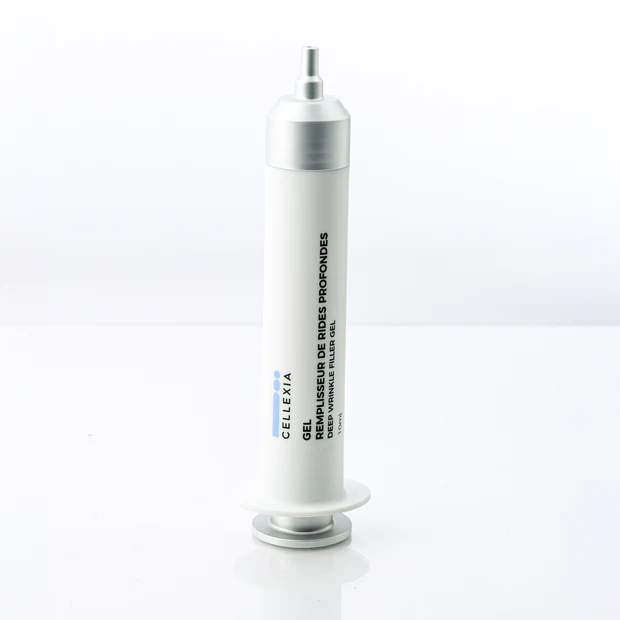
Cellexia produces the only commercial version of the Zurich formula. They call it simply “Deep Wrinkle Filler Gel.”
No celebrities. No fancy packaging. Just the micro-polymer technology that started this investigation.
Cellexia is the first skincare brand to formulate products based on Dr. Elizabeth Blackburn’s Nobel Prize-winning research on cellular aging from 2009.
“Most brands ignored Blackburn’s findings,” notes Dr. Morrison. “Too complex to implement commercially.”
Recognition From Independent Sources

While investigating Cellexia’s background, we discovered they received the 2025 European Cosmetics Prize for innovative formulations. This isn’t a marketing award—it’s chosen by a jury of 27 independent experts who evaluated 350 brands.
More significantly, Verbraucher Berichte—the German consumer association known for rigorous, unbiased testing—named Cellexia’s Deep Wrinkle Filler their number one choice for 2025. They tested over 100 products using laboratory analysis.
We also learned that Cellexia products are used by dermatologists in 138 leading aesthetic clinics across Europe. Not sold—used by the doctors themselves in their treatments.
What Actually Works (And What Doesn’t)

Let’s be clear about what micro-polymer technology cannot do:
It won’t make you 20 again. It won’t eliminate deep scars. It won’t stop aging entirely.
What it does do: Fill existing wrinkles from within. Prevent new ones by maintaining skin structure. Create a microscopic support mesh that holds skin in place.
Think of it like this: Regular creams are like painting over cracks in a wall. Micro-polymers are like filling the cracks first, then smoothing the surface.
The 60-Day Test

Cellexia offers something unusual: Use the entire tube for 60 days. If wrinkles don’t visibly reduce, return even the empty container for a full refund.
“We can make this guarantee because the science is proven,” says their head chemist. “Either molecules penetrate skin or they don’t. Ours do.”
In two years, their return rate is 3%.
Compare that to the 67% of women who stop using traditional anti-aging products within three months due to lack of results.
The Mirror Test

Tomorrow morning, look closely at your deepest wrinkle. The one that bothers you most. Remember exactly how it looks.
Because if you’re using products with molecules larger than 500 Daltons, it will look exactly the same in 60 days. In six months. In a year.
Unless you change what you’re doing.
The women who’ve discovered micro-polymer technology report something different. They talk about catching their reflection and being surprised. About photos they don’t mind being in. About people asking what they’re doing differently.
The dermatologists in those 138 clinics see it every day. That’s why they use it themselves.
The Decision

Every morning, you face the mirror. You see changes you wish weren’t there. You’ve been told it’s inevitable.
It’s not.
Wrinkles form when collagen breaks down in your dermis. If molecules can’t reach your dermis, they can’t help. It’s that simple.
The beauty industry has hidden this for 20 years.
Now you know.
The question is: What will you do with this knowledge?
Will you continue using products that physics proves can’t work? Or will you try the only technology that can actually reach where wrinkles form?
The choice has always been yours. You just didn’t know you had it.
Until now.
Reader Update: Where to Find Cellexia’s Deep Wrinkle Filler Gel

Since publication, we’ve received hundreds of inquiries about accessing the micro-polymer technology discussed in this investigation.
For clarity: Cellexia’s Deep Wrinkle Filler Gel is not sold in stores. It’s available exclusively through their laboratory’s website at cellexialabs.com.
When batches are available, they typically last 3-5 days based on normal demand. Following media coverage, availability windows tend to be shorter. Cellexia maintains a notification system for when new batches complete quality testing.