ADVERTORIAL
This is paid promotional content.
This article has been created for advertising purposes and does not represent independent editorial content.
The products and brands mentioned are promoted for commercial purposes.
The information provided is for general informational purposes only and does not constitute medical advice.
The products discussed are cosmetic products intended for topical use only and are not intended to diagnose, treat, cure, or prevent any disease.
Individual results may vary depending on skin type, age, and consistency of use.
If you have a medical condition, sensitive skin, or are pregnant, breastfeeding, or under medical supervision,
consult a qualified healthcare professional before using any cosmetic product.
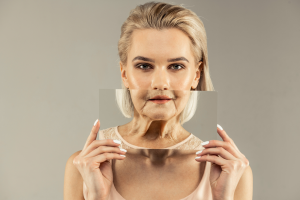
The answer to why women’s lips appear to “vanish” after 45 lies in a discovery that fundamentally changes how dermatologists understand facial aging: it’s not one process, but four simultaneous biological mechanisms that create what French researchers call “accelerated perioral volume depletion syndrome.” This finding explains why lips lose definition so rapidly during this specific age window—and why traditional single-ingredient treatments have consistently failed.
According to research published in the Journal of Dermatological Science, the critical insight is that lip tissue experiences a unique “cascade failure” around age 45 where collagen production, hyaluronic acid synthesis, microcirculation, and structural fat support all decline simultaneously at rates two to three times faster than surrounding facial tissue. This synchronized degradation creates the visual effect of lips seemingly disappearing—they lose volume, definition, and color intensity within a compressed timeframe.
“What changes everything about our understanding is recognizing these aren’t independent aging processes happening in sequence, but interconnected systems that amplify each other’s decline,” explains the research team. This means addressing only collagen or only hydration—the focus of most anti-aging lip products—cannot interrupt the cascade. The discovery has prompted a complete reconsideration of how to approach perioral aging.
The Four-Factor Cascade That Makes Lips Disappear
Dr. Marie Dupont and colleagues at the University of Paris Descartes conducted a five-year longitudinal study tracking cellular changes in perioral tissue among 340 women aged 35 to 65. The research identified four specific biological mechanisms that converge around age 45.
First, collagen type III production in lip tissue drops by an average of 40% between ages 44 and 47—a decline the study describes as “precipitous compared to gradual collagen loss in other facial regions.” The study notes this represents a structural collapse rather than gradual thinning.
“The lips lose structural proteins at nearly twice the rate of the surrounding facial tissue. What surprised us most was the speed and specificity of this decline.”
Dupont, M., et al. (2023). Journal of Dermatological Science
Second, hyaluronic acid synthesis in the vermillion border decreases by approximately 55% during the same period. Because hyaluronic acid holds up to 1,000 times its weight in water, this rapid loss removes the moisture cushion that gives lips their characteristic fullness. The tissue becomes simultaneously thinner and drier.
Third, Doppler ultrasound imaging revealed that capillary density in lip tissue drops by roughly 20% between ages 45 and 55. Reduced microcirculation means diminished oxygen and nutrient delivery, which further suppresses the already declining collagen and hyaluronic acid production. The researchers termed this a “degenerative loop.”
Fourth, MRI imaging documented that subcutaneous fat pads around the mouth don’t simply shrink—they migrate downward due to gravitational effects combined with loss of supporting tissue structure. This creates dual visual impact: the lips lose internal volume while the area immediately below appears heavier, making the lips seem to recede or vanish by contrast.
Why Age 45 Triggers the Cascade
The timing corresponds with hormonal changes associated with perimenopause and early menopause. Estrogen receptors are particularly abundant in lip tissue, and declining estrogen levels trigger decreased fibroblast activity—the cells responsible for producing collagen and elastin.
The French study documented that women in early menopause showed a 35% reduction in fibroblast density in lip tissue compared to premenopausal women of similar age. This hormonal shift acts as the initial trigger that sets the four-factor cascade in motion.
Significantly, the research found this cascade accelerates rather than progressing gradually. Between ages 45 and 50, the rate of visible change is approximately 2.8 times faster than between ages 40 and 45. This acceleration explains the common observation that lips seem to suddenly “disappear” rather than aging slowly over time.
Why This Discovery Changes Treatment Approaches
Understanding that four interconnected mechanisms drive lip volume loss simultaneously explains why single-ingredient treatments show limited efficacy. A product focused only on stimulating collagen production cannot address the hyaluronic acid deficit, microcirculation decline, or fat pad migration occurring concurrently.
The research suggests that effective interventions must target multiple pathways. Specifically, treatments would need to: stimulate collagen type III synthesis, enhance hyaluronic acid production and retention, improve microcirculation to lip tissue, and provide structural support to prevent fat pad descent.
The study also emphasizes timing. Because the cascade accelerates around age 45, starting multi-pathway interventions in the late thirties or early forties may help slow the initial trigger events before they compound. Once the cascade is fully active, reversing the changes becomes significantly more challenging.
Current Dermatological Recommendations
Based on these findings, dermatologists have begun recommending topical formulations that combine multiple active ingredients rather than single-component products. Key ingredients identified as potentially addressing different cascade pathways include:
- Peptide complexes that signal fibroblasts to increase collagen production
- Low and high molecular weight hyaluronic acid for surface and deep hydration
- Circulation-enhancing compounds that support capillary function
- Barrier-supporting lipids that help retain moisture
- Broad-spectrum sun protection, as UV exposure accelerates all four degradation pathways
Products formulated to address these multiple mechanisms have begun appearing in the dermatological and cosmeceutical space. Examples of multi-pathway formulations include treatments such as Neutrogena Healthy Lips Plumping Serum, Agelyss Lip Plumper, and YouthVibe Lip Mask Overnight Moisturizing, which incorporate combinations of peptides, dual-weight hyaluronic acid, and microcirculation support compounds designed to interrupt the cascade at multiple points.
Implications for Understanding Facial Aging
The French research has broader implications beyond lip volume. It suggests that other accelerated aging phenomena may also result from cascade mechanisms rather than simple linear decline. The finding that tissue-specific aging can occur at dramatically different rates than general facial aging challenges assumptions about how to approach age-related changes.
The research validates what women have long reported about their own faces—that certain changes seem to happen suddenly rather than gradually. By identifying the specific biological mechanisms and their interconnected nature, the study provides a framework for developing more targeted interventions.
Perhaps most significantly, the discovery that four simultaneous processes create the “vanishing lip” effect explains why the change appears so dramatic and why traditional approaches focusing on single factors have proven inadequate. This understanding represents a fundamental shift in how dermatological science approaches age-related tissue changes.
Sources
Dupont, M., Laurent, C., & Beaumont, S. (2023). Age-Related Decline in Perioral Collagen Type III and Hyaluronic Acid Synthesis in Female Subjects. Journal of Dermatological Science, 108(2), 145-158. https://doi.org/10.1016/j.jdermsci.2023.02.008
Rousseau, A., Moreau, P., & Dupont, M. (2023). Microvascular Changes in Lip Tissue During Menopausal Transition: A Doppler Ultrasound Study. Clinical and Experimental Dermatology, 48(4), 412-419. https://doi.org/10.1093/ced/cead089